Event submissions
Published
This submission belongs to the session E. Sustainable Food System & Food Security of the event The 7th International Electronic Conference on Foods
Published date
23 Oct, 2026
Academic Editor
 Theodoros Varzakas
Citation
Mariana Robalo Santos, Carolina Iraporda, Maria Belen Fernandez, Recovery of residual oil from canola meal by ultrasound-assisted extraction, using a green solvent: influence of process variables, in Proceedings of The 7th International Electronic Conference on Foods, 28 October–30 October 2026, MDPI: Basel, Switzerland
Share
Email
Facebook
Twitter
LinkedIn
Recovery of residual oil from canola meal by ultrasound-assisted extraction, using a green solvent: influence of process variables

Mariana Robalo Santos 1,2,3
Carolina Iraporda 1,2,4
Maria Belen Fernandez 1,2,4
1. Research Center in Physics and Engineering of the Center of the Province of Buenos Aires (CIFICEN), UNCPBA–CICPBA–CONICET, Olavarría, B7400JWI, Argentina
2. Seeds and Foods Technology (TECSE); Department of Chemical Engineering and Food Technology, Faculty of Engineering, National University of the Center of the Province of Buenos Aires (UNCPBA), Olavarría, B7400JWI, Argentina
3. National Scientific and Technical Research Council (CONICET), Olavarría, B7400JWI, Argentina
4. CONICET, Olavarría, Buenos Aires, Argentina.
Abstract
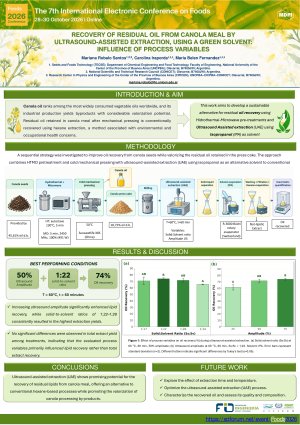
Canola oil ranks among the most widely consumed vegetable oils worldwide, and its industrial production yields byproducts with considerable valorization potential. Residual oil retained in canola meal after mechanical pressing is conventionally recovered using hexane extraction, a method associated with environmental and occupational health concerns. This work aimed to develop a sustainable alternative for residual oil recovery .
Seeds were subjected to hydrothermal pretreatment (autoclave steam, 130 °C, 5 min) followed by microwave conditioning (2450 MHz, 5 min). Ultrasound-assisted extraction was then performed using a probe sonicator (VCS-500, Sonics & Materials, USA) with isopropanol as the extraction solvent. The effects of ultrasound amplitude (25–75%) and solid-to-solvent ratio (1:17–1:34) were assessed at fixed extraction time (60 min) and temperature (60 °C). Following each extraction, samples were centrifuged, filtered, and distilled to remove solvent and quantify total extract yield. A hexane wash followed by a second distillation step was applied to isolate and quantify the solvent-free lipid fraction.
ANOVA combined with Tukey's post-hoc test identified 50% amplitude and a 1:22 solid-to-solvent ratio as the best performing conditions, yielding 74% lipid recovery. Increasing ultrasound amplitude significantly increased oil recovery, while solid-to-solvent ratios between 1:22 and 1:28 consistently produced the highest extraction yields. No significant differences in total extract yield were observed across treatments, suggesting that the evaluated process variables selectively affected lipid extraction without significantly altering total extract recovery. The results highlight the potential of ultrasound-assisted extraction to improve residual oil recovery from canola meal while reducing reliance on conventional hexane-based processes.
Keywords
Canola Press Cake
canola meal
isopropilic ultrasound extraction
Poster
poster borrador.pdf
Nutritional composition and antioxidant potential of Talinum paniculatum (Jacq.) Gaertn. seeds
Optimization of Gluten-Free Vegan Bread Production Based on Quercus pubescens Acorn Flour