Event submissions
Published
This submission belongs to the session E. Sustainable Food System & Food Security of the event The 7th International Electronic Conference on Foods
Published date
23 Oct, 2026
Academic Editor
 Arun K. Bhunia
Citation
Konrad Szczepański, Iga Piasecka-Lenartowicz, Agata Górska, Comparison of the effect of ultrasound and antioxidants application on the stability of fruit seeds oil., in Proceedings of The 7th International Electronic Conference on Foods, 28 October–30 October 2026, MDPI: Basel, Switzerland
Share
Email
Facebook
Twitter
LinkedIn
Comparison of the effect of ultrasound and antioxidants application on the stability of fruit seeds oil.

Konrad Szczepański 1
Iga Piasecka-Lenartowicz 2

Agata Górska 2
1. Faculty of Food Technology, Warsaw University of Life Sciences (SGGW-WULS), 159c Nowoursynowska Street, 02-776 Warsaw, Poland
2. Institute of Food Sciences, Warsaw University of Life Sciences (SGGW-WULS), 159c Nowoursynowska Street, 02-776 Warsaw, Poland
Abstract
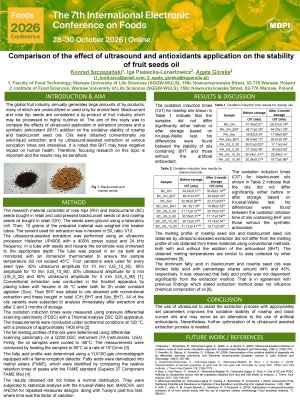
The global fruit industry annually generates large amounts of by-products, many of which are underutilized or used only for animal feed. Blackcurrant and rose hip seeds are considered a by-product of fruit industry which may be processed to highly nutritive oil. The aim of this study was to compare the effects of ultrasound application in extraction process and a syntethicantioxidant (BHT) addition on the oxidative stability of rosehip and blackcurrant seed oils. Oils were obtained conventionally via solid-liquid extraction and by ultrasound-assisted extraction at various sonication times and intensities. The oils were subjected to analysis immediately after extraction and after 2 and 3 months of storage. The DSC, PDSC and GC analysis were performed for all of the oil samples. All oils were characterised by a high content of unsaturated fatty acids. The study determined differences in the oxidative stability of the oils between those with the addition of BHT and those obtained using ultrasound assistedextraction. The average initation time of oxidation for blackcurrant seed oils ranged from 30.56 to 46.47 minutes, and for rosehip seed oils, from 30.82 to 48.71 minutes. However, the stability of oils obtained from black currant seeds at a time of 5 minutes and amplitudes of 30% and 90%, as well as from rosehip seeds at a time of 10 minutes and an amplitude of 90%, did not differ from that of conventionally extracted oils. Optimization of ultrasound assisted extraction process made itpossible to obtain oils from fruit seeds with a prolongedoxidation induction time.
Keywords
blackcurrant seeds
rose hip seeds
fruit seeds oil
ultrasound assisted extraction
BHT
oxidative stability
Poster
FOODS2026 Szczepański, Piasecka-Lenartowicz, Górska.pdf
Drying Technology and Thermal Pre-Treatment Shape the Nutritional,
Phytochemical, and Safety Profile of Wine Lees Powders from Different Grape Varieties
Phytochemical, and Safety Profile of Wine Lees Powders from Different Grape Varieties
Coffee Silverskin Extract as a Functional Ingredient for the Development of Caffeinated Gummies