Event submissions
Published
This submission belongs to the session B. Nutritional & Functional Foods of the event The 7th International Electronic Conference on Foods
Published date
23 Oct, 2026
Academic Editor
 Nazimah Hamid
Citation
Laura Candela Salvador, Raquel Lucas González, Juana Fernández López, José Ángel Pérez Álvarez, Manuel Viuda Martos, Coffee Silverskin Extract as a Functional Ingredient for the Development of Caffeinated Gummies, in Proceedings of The 7th International Electronic Conference on Foods, 28 October–30 October 2026, MDPI: Basel, Switzerland
Share
Email
Facebook
Twitter
LinkedIn
Coffee Silverskin Extract as a Functional Ingredient for the Development of Caffeinated Gummies

Laura Candela Salvador 1

Raquel Lucas González 2

Juana Fernández López 1
José Ángel Pérez Álvarez 1

Manuel Viuda Martos 1
1. Grupo IPOA, CIAGRO-UMH, Universidad Miguel Hernández, Elche, Spain
2. IPOA Research Group, Agro-Food Technology Departament, Centro de Investigación e Innovación Agroalimentaria y Agroambiental (CIAGRO-UMH), Miguel Hernández University, 03312, Orihuela, Spain.
Abstract
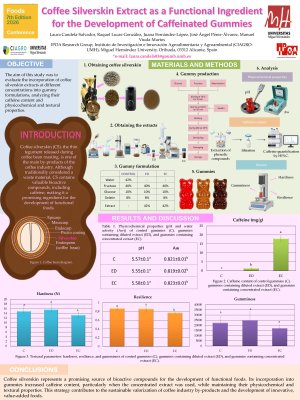
Coffee silverskin (CS), the thin tegument released during coffee bean roasting, is one of the main by-products of the coffee industry. Although traditionally considered a waste material, CS contains valuable bioactive compounds, including caffeine, making it a promising ingredient for functional foods. This study evaluated the incorporation of CS extracts at different concentrations into gummy formulations: a diluted extract (ED; 4.35 mg/g caffeine) and a concentrated extract (EC; 11.45 mg/g caffeine).
Three formulations were prepared: control (C), gummies containing diluted CS extract (ED), and gummies containing concentrated CS extract (EC). Physicochemical properties included pH, measured using a pH meter, and water activity (Aw), measured using a Novasina instrument. Texture parameters (hardness, gumminess, and resilience) were determined by Texture Profile Analysis (TPA) using a texture analyzer. Caffeine was extracted from the samples and quantified by HPLC. Statistical analyses were performed to identify significant differences among formulations (p < 0.05).
The primary finding was that CS extract significantly increased caffeine content in a concentration-dependent manner. No caffeine was detected in control samples, whereas ED gummies contained 1.51 ± 0.25 mg/g, corresponding to 9.79 mg per gummy (6.5 g). EC gummies showed the highest caffeine concentration, reaching 18.03 ± 1.58 mg/g, equivalent to 117.18 mg per gummy.
As secondary findings, CS extract did not significantly affect physicochemical or textural properties. pH values ranged from 5.55 to 5.58, while Aw remained between 0.819 and 0.823. Hardness ranged from 14.97 to 15.65 N, gumminess from 22,475.89 to 24,816.85, and resilience from 0.86 to 0.87, indicating that CS extract did not compromise gummy texture.
These findings demonstrate that CS extract can be successfully incorporated into gummies, increasing caffeine content while maintaining physicochemical and textural properties. Thus, CS represents a sustainable functional ingredient for valorizing coffee industry by-products and developing innovative value-added foods.
Keywords
caffeine
coffee silverskin
gummies
texture
Poster
Poster congreso Foods 2026.pdf
Comparison of the effect of ultrasound and antioxidants application on the stability of fruit seeds oil.
What’s Brewing in Tea? A Decade of Food Safety Alerts in the EU RASFF Database