Event submissions
Published
This submission belongs to the session G. Food Safety, Toxicology & Quality of the event The 7th International Electronic Conference on Foods
Published date
23 Oct, 2026
Academic Editor
 Esther Sendra
Citation
Una Gajic, Dunja Kobiljski, Ljilja Torovic, What’s Brewing in Tea? A Decade of Food Safety Alerts in the EU RASFF Database, in Proceedings of The 7th International Electronic Conference on Foods, 28 October–30 October 2026, MDPI: Basel, Switzerland
Share
Email
Facebook
Twitter
LinkedIn
What’s Brewing in Tea? A Decade of Food Safety Alerts in the EU RASFF Database

Una Gajic 1
Dunja Kobiljski 2

Ljilja Torovic 1
1. Department of Pharmacy, Faculty of Medicine, University of Novi Sad, 21000 Novi Sad, Serbia
2. Department of Industrial Engineering and Management, Faculty of Technical Sciences, University of Novi Sad, Novi Sad 21000, Serbia.
Abstract
Tea is a globally traded commodity subject to extensive food-safety surveillance, but safety notification frequencies must be interpreted in the context of trade patterns, targeted controls, and differences in regulatory requirements between producing and importing countries.
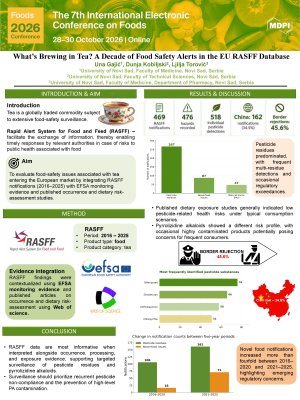
This study evaluated food-safety issues associated with tea entering the European market by integrating notifications from the European Union Rapid Alert System for Food and Feed (RASFF) for 2016–2025 with European Food Safety Authority (EFSA) monitoring evidence, and published occurrence and dietary risk-assessment studies.
A total of 469 RASFF notifications involving 476 hazards were identified. Pesticide residues predominated (267 notifications; 518 individual pesticide detections), followed by novel-food issues (87) and natural toxins (47; pyrrolizidine alkaloids). China accounted for the largest number of notifications (162; 34.5%), consistent with its prominent role in tea supplied to the European market. However, differences in notification numbers among countries cannot be interpreted directly as differences in product safety because notification frequency is influenced by import volume and intensity of official controls. Border rejections represented 45.6% of notifications, emphasizing the role of import surveillance in intercepting non-compliant consignments. Published occurrence studies corroborated the predominance of pesticide contamination, particularly multi-residue profiles and occasional exceedances involving pesticides not authorized in the EU. Nevertheless, dietary exposure assessments generally indicate low pesticide-related health risks under typical tea-consumption scenarios. Pyrrolizidine alkaloids showed a different risk profile, characterized by highly heterogeneous occurrence and occasional heavily contaminated products that may be of concern for frequent consumers and vulnerable groups. Processing and brewing can further modify the transfer of contaminants into the consumed infusion.
Overall, RASFF notifications primarily identify regulatory and import-control priorities rather than population-level health risk. Their interpretation alongside trade patterns, occurrence data, processing factors, and exposure assessments supports more targeted surveillance focused on recurrent pesticide non-compliance and prevention of high-level pyrrolizidine alkaloid contamination.
Keywords
public health
food safety
RASFF
Poster
Foods poster Tea.pdf
Coffee Silverskin Extract as a Functional Ingredient for the Development of Caffeinated Gummies
Supercritical CO₂ Extraction of the Oat Lipids for Functional Food Ingredients