Event submissions
Published
This submission belongs to the session B. Nutritional & Functional Foods of the event The 7th International Electronic Conference on Foods
Published date
23 Oct, 2026
Academic Editor
 Manuel Viuda-Martos
Citation
STEPHANIE MARIEL FLORES-COLORADO, ALBERTO BARRERA-PACHECO, Ana Paulina Barba de la Rosa, Characterization of bioactive peptides released during the fermentation of amaranth seeds with their endophytic bacteria, in Proceedings of The 7th International Electronic Conference on Foods, 28 October–30 October 2026, MDPI: Basel, Switzerland
Share
Email
Facebook
Twitter
LinkedIn
Characterization of bioactive peptides released during the fermentation of amaranth seeds with their endophytic bacteria

STEPHANIE MARIEL FLORES-COLORADO 1
ALBERTO BARRERA-PACHECO 1
Ana Paulina Barba de la Rosa 1
1. Instituto Potosino de Investigación Científica y Tecnológica A.C., San Luis Potosi, 78216, Mexico
Abstract
Introduction
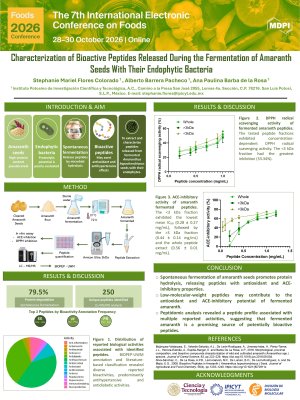
Increasing interest has been taken in the therapeutic potential of Bioactive Peptides (BAPs), which are released from native proteins through hydrolysis. A promising method for breaking down food proteins is fermenting high-protein grains and seeds. To date, the application of fermentation of amaranth seeds with their endophytic microorganisms to produce BAPs has not been explored. Therefore, this study aimed to characterize the peptidome of fermented amaranth seeds and evaluate the potential bioactivity of the released peptides.
Methods
Amaranth seed protein hydrolysis was performed by spontaneous fermentation at a 1:2.5 solid-liquid ratio for 72h. Extracted peptides were screened for bioactivity using in vitro assays, and peptidomic analysis was conducted by using LC-MS/MS.
Results and Discussion
Amaranth flour fermentation resulted in peptide enrichment below 3.5 kDa with a total protein degradation percent of 79.5%. More than 250 unique peptides were identified and tested in BIOPEP-UWM to assess their potential bioactivities. The most prevalent was the dipeptide Glu-Glu, which has been linked to neuroprotective, antihypertensive, anticancer, and antibacterial activities. Furthermore, released peptides exhibited DPPH–inhibitory activity in vitro with IC50 values of 0.96 ± 0.1 mg/mL, 1.06 ± 0.1 mg/mL, and 1.36 ± 0.1 mg/mL for peptides under 3 kDa, below 3kDa, and the whole peptide population, respectively.
Conclusions
Data show that spontaneous fermentation of amaranth seeds is an effective and reliable method for producing BAPs. The assay to test the neuroprotective and antihypertensive potential of these peptides is in progress.
Keywords
amaranth
bioactive peptides
endophyte
fermentation
DPPH activity
Poster
Poster Sciforum-197903.pdf
Amino acid and fatty acid composition of two sweet tomatillo species (Physalis gracilis and Physalis grisea)
In vitro biochemical investigation of the antioxidant, anti-inflammatory and antithrombotic bioactivities of wine extracts from Pangeo Mountain originated organic grapes with health promoting properties