Event submissions
Published
This submission belongs to the session B. Nutritional & Functional Foods of the event The 7th International Electronic Conference on Foods
Published date
23 Oct, 2026
Academic Editor
 Manuel Viuda-Martos
Citation
Elisa Mariana García, Analía Verónica Medina, Silvana Ruiz, Milagros Rojas, Mónica Azucena Nazareno, Bioactive Phenolic Extracts from Native Argentine Chaco Plants: Characterization and Potential Food Applications, in Proceedings of The 7th International Electronic Conference on Foods, 28 October–30 October 2026, MDPI: Basel, Switzerland
Share
Email
Facebook
Twitter
LinkedIn
Bioactive Phenolic Extracts from Native Argentine Chaco Plants: Characterization and Potential Food Applications

Elisa Mariana García 1,2
Analía Verónica Medina 1

Silvana Ruiz 3
Milagros Rojas 1
Mónica Azucena Nazareno 1,2
1. Instituto de Ciencias Químicas (ICQ), Facultad de Agronomía y Agroindustrias (FAyA), Universidad Nacional de Santiago del Estero (UNSE), Santiago del Estero, 4200, Argentina
2. Consejo Nacional de Investigaciones Científicas y Técnicas, (CONICET), Santiago del Estero, 4200, Argentina
3. Instituto Nacional de Tecnología Agropecuaria , (INTA), Santiago del Estero, 4200, Argentina
Abstract
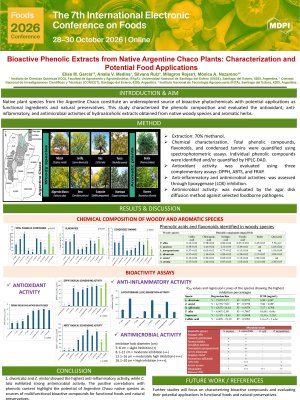
Native plant species from the Argentine Chaco constitute an underexplored source of bioactive phytochemicals with potential applications as functional ingredients and natural preservatives. This study characterized the phenolic composition and evaluated the antioxidant, anti-inflammatory, and antimicrobial activities of hydroalcoholic extracts obtained from native woody species and aromatic herbs. Leaves from Celtis tala, Prosopis alba, Acacia aroma Gillies ex Hook. & Arn, Larrea divaricate Cav., Ziziphus mistol Griseb, Libidibia paraguariensis (D. Parodi) G.P. Lewis, Cercidium praecox (Ruiz & Pav.), and Capparis atamisquea, together with Rosmarinus officinalis and Peumus boldus, were extracted using 70% methanol. Total phenolic compounds, flavonoids, and condensed tannins were determined by spectrophotometric assays. Individual phenolic profiles were analyzed by HPLC-DAD. Antioxidant activity was assessed using DPPH, ABTS, and FRAP assays. Anti-inflammatory activity was evaluated through lipoxygenase (LOX) inhibition, while antimicrobial activity was determined by agar disk diffusion against foodborne pathogens. Significant interspecific variability was observed in phytochemical composition and bioactivities. L. divaricata, Z. mistol, and P. boldus exhibited the highest phenolic contents and antioxidant capacities. HPLC-DAD analysis identified gallic acid, chlorogenic acid, syringic acid, rutin, ferulic acid, and quercetin as major constituents. Extracts from L. divaricata and Z. mistol showed the strongest LOX inhibition, with IC₅₀ values lower than those of naproxen. C. tala demonstrated high antimicrobial activity against Salmonella enteritidis, whereas A. aroma and C. paraguariensis showed moderate inhibition. Strong positive correlations were found between total phenolic content and antioxidant and anti-inflammatory activities. Native species from the Argentine Chaco represent promising sources of multifunctional phytochemicals with antioxidant, anti-inflammatory, and antimicrobial properties, supporting their potential application in the development of functional foods and natural preservatives.
Keywords
Bioactive phytochemicals
Phenolic compounds
Antioxidant activity
Anti-inflammatory activity
Lipoxygenase inhibition
Natural antimicrobials
Functional ingredients
Food preservation
Poster
Sciforum-197738_Bioactive Phenolic Extracts from Native Argentine Chaco Plants.pdf
Subcritical water extraction of tiger nut by-products: Assessment of nutritional value and safety
STORAGE STABILITY OF HORSERADISH PEROXIDASE IMMOBILIZED IN ALGINATE BEADS REINFORCED WITH ALMOND SHELL-DERIVED NANOCELLULOSE