Event submissions
Published
This submission belongs to the session E. Sustainable Food System & Food Security of the event The 7th International Electronic Conference on Foods
Published date
23 Oct, 2026
Academic Editor
 Davide Papurello
Citation
Miguel Pellicer, Mikhail Grachev, Esperanza Dalmau, Diego Morales Urrea, Alex López Córdoba, Valeria S. Eim, STORAGE STABILITY OF HORSERADISH PEROXIDASE IMMOBILIZED IN ALGINATE BEADS REINFORCED WITH ALMOND SHELL-DERIVED NANOCELLULOSE, in Proceedings of The 7th International Electronic Conference on Foods, 28 October–30 October 2026, MDPI: Basel, Switzerland
Share
Email
Facebook
Twitter
LinkedIn
STORAGE STABILITY OF HORSERADISH PEROXIDASE IMMOBILIZED IN ALGINATE BEADS REINFORCED WITH ALMOND SHELL-DERIVED NANOCELLULOSE

Miguel Pellicer 1
Mikhail Grachev 1
Esperanza Dalmau 1
Diego Morales Urrea 2
Alex López Córdoba 2
Valeria S. Eim 1
1. Department of Chemistry, Universitat de les Illes Balears, Palma de Mallorca 07122, Balearic Islands, Spain.
2. Bioeconomy and Agri-food Sustainability Research Group, School of Agricultural Business Administration, Duitama Sectional Faculty, Universidad Pedagógica y Tecnológica de Colombia, Duitama 150461, Boyacá, Colombia.
Abstract
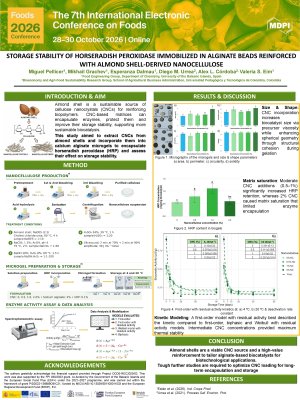
Valorising almond-processing residues as functional materials for enzyme immobilisation can support circular agri-food systems; however, their effects on long-term enzyme retention and storage stability are unclear. This study investigated the use of cellulose nanocrystals (CNCs) isolated from almond shells as reinforcement for calcium alginate beads containing horseradish peroxidase (HRP). Isolation yielded a CNC suspension of 40.3 ± 0.4 mg/mL. Transmission electron microscopy showed elongated rod-like particles 200–800 nm long, while Fourier-transform infrared spectroscopy revealed characteristic cellulose bands and no lignin-associated signal near 1510 cm⁻¹, indicating effective delignification. CNCs were incorporated at 0, 0.5, 1.0, and 2.0 wt.%, and HRP loading, initial activity, and deactivation over 96 days at 4 and 20 °C were assessed. Three independent bead batches were divided according to temperature. At each sampling time, three 12-bead subsamples were analysed per batch and temperature (n = 3 independent batches). Data for each temperature were evaluated using two-way ANOVA followed by Tukey’s HSD test (α = 0.05). HRP loading increased from 0.55 ± 0.04 mg/mL without CNCs to 1.07 ± 0.20 mg/mL at 1.0 wt.% but decreased to 0.59 ± 0.13 mg/mL at 2.0 wt.%. The 2.0 wt.% formulation showed the highest initial activity (0.90 ± 0.03 U/g versus approximately 0.50 ± 0.06 U/g for formulations containing ≤1.0 wt.%) but faster storage deactivation. Activity decay followed a biphasic first-order model (R² ≥ 0.95), declining markedly during the first 14 days, and more slowly thereafter. Storage at 4 °C preserved activity better than at 20 °C; at 4 °C, 0.5 and 1.0 wt.% showed the lowest deactivation rates, whereas 2.0 wt.% reached k = 0.20 ± 0.02 d⁻¹. The non-monotonic CNC effects may reflect concentration-dependent changes in enzyme–matrix interactions and alginate network organisation, influencing HRP retention, substrate accessibility, and storage stability.
Keywords
horseradish peroxidase
enzyme immobilization
calcium alginate beads
almond shell-derived nanocellulose
storage stability
sustainable biocatalysts
Poster
Pellicer_Miguel_Poster_Foods.pdf
Bioactive Phenolic Extracts from Native Argentine Chaco Plants: Characterization and Potential Food Applications
Investigating Biofilm Formation by Endophytic Bacteria from Plant Roots under Thermal and Nutritional Stress: Implications for Sustainable Crop Resilience and Food Safety