Event submissions
Published
This submission belongs to the session E. Sustainable Food System & Food Security of the event The 7th International Electronic Conference on Foods
Published date
23 Oct, 2026
Academic Editor
 Arun K. Bhunia
Citation
Siham Tounssi, Noureddine Hamamouch, Ilham Zahir, Efstathios Giaouris, Investigating Biofilm Formation by Endophytic Bacteria from Plant Roots under Thermal and Nutritional Stress: Implications for Sustainable Crop Resilience and Food Safety, in Proceedings of The 7th International Electronic Conference on Foods, 28 October–30 October 2026, MDPI: Basel, Switzerland
Share
Email
Facebook
Twitter
LinkedIn
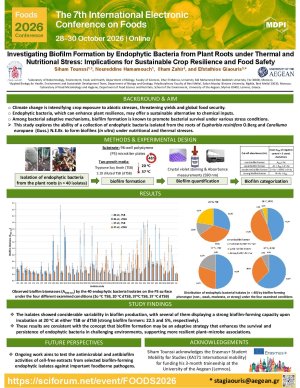
Investigating Biofilm Formation by Endophytic Bacteria from Plant Roots under Thermal and Nutritional Stress: Implications for Sustainable Crop Resilience and Food Safety

Siham Tounssi 1,2
Noureddine Hamamouch 1
Ilham Zahir 3

Efstathios Giaouris 2
1. Laboratory of Biotechnology, Environment, Food, and Health, Department of Biology, Faculty of Sciences, Dhar El Mahraz, University Sidi Mohammed Ben Abdellah University, Fez 30000, Morocco.
2. Laboratory of Food Microbiology and Hygiene, Department of Food Science and Nutrition, School of the Environment, University of the Aegean, Myrina 81400, Lemnos, Greece.
3. Applied Biology for Health, Environment and Sustainable Development Team, Department of Biology and Geology, Polydisciplinary Faculty of Beni Mellal, Sultan Moulay Slimane University, Mghila, Beni Mellal 23030, Morocco.
Abstract
Climate change and resource constraints are increasing crops' exposure to abiotic stresses, with direct consequences for yields and global food security. In this context, endophytic bacteria that promote plant resilience and reduce the need for synthetic inputs represent a promising tool for sustainable food systems. This study investigated endophytic bacteria isolated from the roots of Euphorbia resinifera O.Berg and Caralluma europaea (Guss.) N.E.Br and evaluated their biofilm-forming ability under nutritional and thermal stress conditions. A total of 40 endophytic bacterial isolates were obtained after root surface sterilization and cultivation on appropriate growth media. Biofilm formation was assessed in polystyrene microtiter plates using the crystal violet staining method after 48 h of incubation. Isolates were tested under two nutritional conditions, using either tryptone soy broth (TSB) or 1:10 diluted TSB, and two temperatures, 20 °C and 37 °C, to simulate normal and stress conditions. The isolates showed considerable variability in biofilm production, with several strains displaying increased biofilm formation under stress, particularly at elevated temperature. These results suggest that biofilm formation may be an adaptive strategy that enhances the survival and persistence of endophytic bacteria in challenging environments, supporting more resilient plant–microbe associations. Ongoing work aims to select biofilm-forming endophytic strains and evaluate whether their cell-free extracts can inhibit biofilm formation by foodborne pathogens, thereby linking plant resilience with safer, more sustainable food production.
Acknowledgements: Siham Tounssi acknowledges the Erasmus+ Student Mobility for Studies (KA171 International mobility) for funding his 3-month traineeship at the University of the Aegean (Lemnos).
Keywords
endophytic bacteria
biofilm formation
Euphorbia resinifera
Caralluma europaea
thermal stress
nutritional stress
plant–microbe interactions
sustainable food systems
food security
Poster
Tounssi et al._POSTER.pdf
STORAGE STABILITY OF HORSERADISH PEROXIDASE IMMOBILIZED IN ALGINATE BEADS REINFORCED WITH ALMOND SHELL-DERIVED NANOCELLULOSE
Effect of slightly acidic electrolyzed water against pathogenic microorganisms inoculated on chicken skin