Event submissions
Published
This submission belongs to the session E. Sustainable Food System & Food Security of the event The 7th International Electronic Conference on Foods
Published date
23 Oct, 2026
Academic Editor
 Arun K. Bhunia
Citation
Nicolás Alexander Montero Muñoz, Andrea Están, Susana Simal, Carmen Roselló, Mónica Umaña, EFFECT OF ACID HYDROLYSIS CONDITIONS ON THE PHYSICOCHEMICAL PROPERTIES OF NANOCELLULOSE FROM ALMOND-SHELL-DERIVED CELLULOSE, in Proceedings of The 7th International Electronic Conference on Foods, 28 October–30 October 2026, MDPI: Basel, Switzerland
Share
Email
Facebook
Twitter
LinkedIn
EFFECT OF ACID HYDROLYSIS CONDITIONS ON THE PHYSICOCHEMICAL PROPERTIES OF NANOCELLULOSE FROM ALMOND-SHELL-DERIVED CELLULOSE

Nicolás Alexander Montero Muñoz 1
Andrea Están 1
Susana Simal 1
Carmen Roselló 1
Mónica Umaña 1
1. Chemistry Department, University of the Balearic Islands, Ctra. Valldemossa, km 7.5, 07122 Palma, Balearic Islands, Spain
Abstract
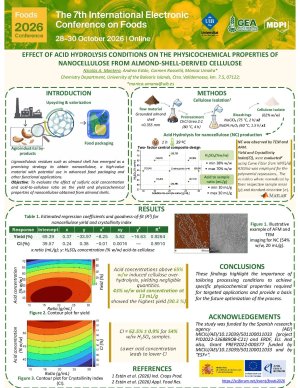
The growth of the food industry has increased interest in the valorization of agro-industrial by-products. Consequently, the upcycling of lignocellulosic residues such as almond shell (AS) has emerged as a promising strategy to obtain nanocellulose (NC), a high-value material with potential use in advanced food packaging and other functional applications. In this study, AS was pretreated with a natural deep eutectic solvent (choline chloride:urea, 2:1 mass ratio, 4 h at 80 °C) and subsequently bleached to isolate cellulose [NaClO₂ 1.3%, 2 h, 75 °C, x2; NaOH 10%:H2O2 6%:H2O (1:1:100), 1.5 h, 60 °C]. Thereafter, acid hydrolysis was performed to obtain NC. A two-factor central composite design was employed to investigate the effects of H2SO4 concentration (38 to 70 wt%) and acid-to-cellulose ratio (10 to 30 mL g⁻¹) on the characteristics of the resulting NC. The resulting materials were characterized by mass yield, TEM and AFM imaging, X-ray diffraction and FTIR spectroscopy. Experiments demonstrated that acid concentrations above 65 wt% induced cellulose over-hydrolysis, yielding negligible results. Meanwhile, microscopic observations confirmed the successful transformation of cellulose into NC, revealing both nanocrystal and nanofiber morphologies in the remaining samples. XRD unveiled significant differences in the crystallinity index (CI) across the nine samples, with the highest CI values consistently observed in those hydrolyzed at 54 wt% acid, averaging 62.5% ± 0.9%, regardless of the sample-to-acid ratio. The FTIR spectra showed that all the samples preserved the characteristic cellulose absorption bands. The results demonstrated that hydrolysis conditions strongly influenced the mass yield, NC morphology and crystallinity index, maintaining the characteristic chemical structure of cellulose. These findings highlight the importance of tailoring processing conditions to achieve specific physicochemical properties required for targeted applications and provide a basis for the future optimization of the process.
Keywords
Almond shell valorization
Nanocellulose
Agri-food by-products
Upcycling
Acid hydrolysis
Poster
Poster_Foods.pdf
Effect of slightly acidic electrolyzed water against pathogenic microorganisms inoculated on chicken skin
A mathematical simulator to evaluate the crop production in agrivoltaic systems