Event submissions
Published
This submission belongs to the session E. Sustainable Food System & Food Security of the event The 7th International Electronic Conference on Foods
Published date
23 Oct, 2026
Academic Editor
 Arun K. Bhunia
Citation
Antoni Capellà, Henry Alexander Váquiro, Esperanza Dalmau, Jairo Garcia Lozano, Susana Simal, A mathematical simulator to evaluate the crop production in agrivoltaic systems, in Proceedings of The 7th International Electronic Conference on Foods, 28 October–30 October 2026, MDPI: Basel, Switzerland
Share
Email
Facebook
Twitter
LinkedIn
A mathematical simulator to evaluate the crop production in agrivoltaic systems

Antoni Capellà 1
Henry Alexander Váquiro 2
Esperanza Dalmau 1
Jairo Garcia Lozano 2
Susana Simal 1
1. Faculty of Sciences, Department of Chemistry, University of the Balearic Islands, Palma de Mallorca, 0712, Spain
2. Faculty of Agromomic Engineering, Universidad del Tolima, Ibagué, 730006299, Colombia
Abstract
Agrivoltaic systems may contribute to sustainable food systems by combining crop production and photovoltaic energy generation on the same surface, especially in territories where land availability is limited. This work presents a simulator designed as a decision-support tool for the preliminary assessment of agrivoltaic systems in Mediterranean and Tropical regions, with special attention to crops of local interest.
The simulator was developed from scientific literature, agronomic information and solar radiation databases. It allows users to configure scenarios by defining geographical location, simulation period, terrain resolution, albedo, photovoltaic geometry, module height, tilt, transparency, row spacing, crop type and baseline yield. The selected crops are assigned to shade-tolerance groups according to literature data, allowing comparison between species with different responses to reduced radiation. The terrain is discretised into a two-dimensional mesh, where solar position and shading patterns are calculated at 15-min intervals. Direct, diffuse and global radiation data are obtained from PVGIS typical meteorological year datasets to estimate irradiance distribution at ground level. Crop productivity is evaluated through the relative shading ratio, and yield is estimated using empirical equations specific to each shade-tolerance group.
The simulator provides accumulated irradiance maps, monthly photovoltaic energy production, the proportion of cultivated area affected by different shading intervals and relative crop yield. These outputs make it possible to analyse how photovoltaic design modifies light availability and crop performance. In simulations comparing different horticultural crops such as chard, pepper and onion, chard showed the best performance under shade, pepper an intermediate response, and onion the greatest sensitivity to radiation reduction. Overall, the simulator offers a reproducible framework to explore agrivoltaic configurations, support crop selection and guide the design of systems aimed at improving food security, renewable energy production and land-use efficiency.
Keywords
Agrivoltaics
decision-support simulator
crop shade tolerance
photovoltaic shading
food security
land-use efficiency
Poster
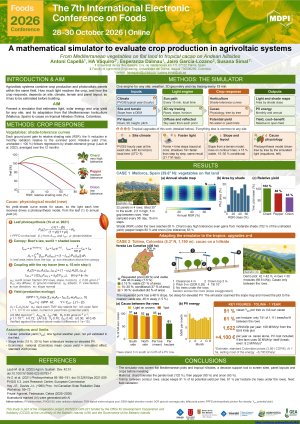
A mathematical simulator to evaluate the crop production in agrivoltaic systems_FOODS2026_Capella.pdf
EFFECT OF ACID HYDROLYSIS CONDITIONS ON THE PHYSICOCHEMICAL PROPERTIES OF NANOCELLULOSE FROM ALMOND-SHELL-DERIVED CELLULOSE
Suitability of Gluten-Free Offerings in Spanish Food Service Establishments: An Exploratory Study of Safety and Allergen Management Practices