Event submissions
Published
This submission belongs to the session G. Food Safety, Toxicology & Quality of the event The 7th International Electronic Conference on Foods
Published date
23 Oct, 2026
Academic Editor
 Esther Sendra
Citation
Ana Martorell Nevot, Sandra Fernández-Pastor, Cristina Zomeño Segado, Ana Guerrero Barrado, Suitability of Gluten-Free Offerings in Spanish Food Service Establishments: An Exploratory Study of Safety and Allergen Management Practices, in Proceedings of The 7th International Electronic Conference on Foods, 28 October–30 October 2026, MDPI: Basel, Switzerland
Share
Email
Facebook
Twitter
LinkedIn
Suitability of Gluten-Free Offerings in Spanish Food Service Establishments: An Exploratory Study of Safety and Allergen Management Practices

Ana Martorell Nevot 1
Sandra Fernández-Pastor 1
Cristina Zomeño Segado 1
Ana Guerrero Barrado 1
1. Department of Animal Production and Health, Public Veterinary Health and Food Science and Technology, Universidad Cardenal Herrera-CEU, CEU Universities, Alfara del Patriarca, Valencia, 46115, Spain
Abstract
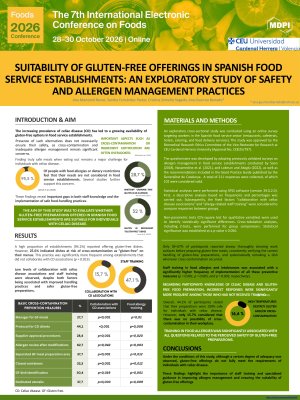
The increasing prevalence of celiac disease has led to a growing availability of gluten-free options in food service establishments. However, the presence of such alternatives does not necessarily ensure their safety, as cross-contamination and inadequate allergen management remain significant concerns. The aim of this study was to evaluate whether gluten-free preparations offered in Spanish food service establishments are suitable for individuals with celiac disease.
An exploratory cross-sectional study was conducted using an online survey targeting workers in the Spanish food service sector (restaurants, cafeterias, hotels, catering, and food delivery services). A total of 211 responses were collected, of which 102 were considered valid. First, a descriptive analysis of all variables was performed. Then, the effect of several factors—such as collaboration with celiac disease associations and staff training in food allergies—was assessed, including comparisons between groups (P ≤ 0.05).
A high proportion of establishments (94.1%) reported offering gluten-free dishes; however, 25.6% identified foods exposed to cross-contamination as “gluten-free” on their menus. Low levels of collaboration with celiac disease associations (13.7%) and staff training (47.1%) were observed, despite both factors being associated with improved handling practices and safer gluten-free preparations. Untrained participants more frequently reported moderate to high probabilities of gluten cross-contamination during preparation (P < 0.001) and showed greater misconceptions regarding gluten management, including the incorrect belief that high temperatures can eliminate gluten (14.6%; P = 0.001)
Establishments collaborating with celiac disease associations were more likely to have designated personnel and specific protocols for gluten-free preparations (P < 0.001).
Under the conditions of this study, although a certain degree of adequacy was observed, gluten-free offerings do not fully meet the requirements of individuals with celiac disease. These findings highlight the importance of staff training and specialized guidance in improving allergen management and ensuring the suitability of gluten-free offerings
Keywords
Allergen management
Celiac disease
Cross-contamination
food safety
Staff training
Poster
Martorell et al Foods poster.pdf
A mathematical simulator to evaluate the crop production in agrivoltaic systems
Exploring the effect of cricket (Acheta domesticus)-enriched pasta on gut microbiota after in vitro colonic fermentation