Event submissions
Published
This submission belongs to the session B. Nutritional & Functional Foods of the event The 7th International Electronic Conference on Foods
Published date
23 Oct, 2026
Academic Editor
 Manuel Viuda-Martos
Citation
Leonardo Musto, Mussa Makran, Dario Mercatante, Maria Teresa Rodríguez-Estrada, Ivan Albano, Antonio Cilla, Guadalupe Garcia-Llatas, María Ruiz-Rico, Exploring the effect of cricket (Acheta domesticus)-enriched pasta on gut microbiota after in vitro colonic fermentation, in Proceedings of The 7th International Electronic Conference on Foods, 28 October–30 October 2026, MDPI: Basel, Switzerland
Share
Email
Facebook
Twitter
LinkedIn
Exploring the effect of cricket (Acheta domesticus)-enriched pasta on gut microbiota after in vitro colonic fermentation

Leonardo Musto 1

Mussa Makran 2
Dario Mercatante 3
Maria Teresa Rodríguez-Estrada 3
Ivan Albano 4

Antonio Cilla 1

Guadalupe Garcia-Llatas 1
María Ruiz-Rico 1
1. Nutrition and Food Science Area, Faculty of Pharmacy and Food Sciences, University of Valencia, 46100, Burjassot, Valencia, Spain
2. Nutrition Department, Faculty of Health Sciences, University Fernando Pessoa Canarias, C/ la Juventud, s/n, 35450, Santa María de Guía, Las Palmas, Spain
3. Department of Agricultural and Food Sciences, Alma Mater Studiorum, Università di Bologna, Viale Fanin 40, 40127, Bologna, Italy
4. Italian Cricket Farm, Via Vigone 20, 10060 Scalenghe, Italy
Abstract
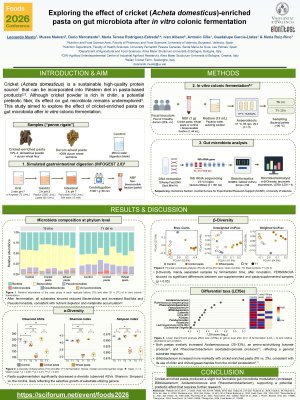
Introduction: Cricket (Acheta domesticus) is a sustainable high-quality protein source that can be incorporated into Western diet in pasta-based products. Although cricket powder is rich in chitin, a potential prebiotic fiber, its effect on gut microbiota remains underexplored. Methodology: Static in vitro colonic fermentation was performed using the non-bioaccessible fractions from simulated gastrointestinal digestion (INFOGEST 2.0) of cricket-enriched pasta (10% A. domesticus powder) and durum wheat pasta, compared with a control (non-bioaccessible fraction of digested Milli-Q water). Fermentation comprising a simple medium, the non-bioaccesible fractions and a pooled fecal inoculum from three healthy donors were incubated under simulated colonic conditions (anaerobiosis, 37 °C, 85 rpm, 20 h; n=3). Bacterial DNA was extracted, the V3–V4 region of 16S rRNA was sequenced (Illumina MiSeq), and α-/β-diversity, taxonomic abundances and differential taxa (LEfSe) were analyzed using MicrobiomeAnalyst. Results and discussion: After fermentation, all substrates showed reduced Bacteroidota and increased Bacillota and Pseudomonadota, consistent with nutrient depletion and metabolite accumulation. Pasta supplementation significantly decreased α-diversity (observed ASVs, Shannon, Simpson) versus the control. β-diversity (PCoA, Bray–Curtis and UniFrac) mainly separated samples by fermentation time, with no clear separation between non-supplemented and pasta-supplemented samples after incubation (PERMANOVA, p>0.05). Nevertheless, LEfSe analysis revealed that both pastas similarly increased the abundance of Acidaminococcus (25–33%), an amino-acid-utilizing butyrate producer, and of Phascolarctobacterium (acetate/propionate producer), reflecting a general substrate response rather than a cricket-specific effect. In contrast, the abundance of Bifidobacterium increased more markedly with cricket-enriched pasta (5% vs. 2%), consistent with its utilization of chitin and chitooligosaccharides from cricket exoskeleton as carbon sources. These shifts could be associated with enhanced short-chain fatty acid production and positive fiber-driven ecosystem modulation. Conclusion: Cricket-enriched pasta produced a slight but favorable gut microbiota modulation, supporting a potential prebiotic effect that requires further research.
Keywords
Cricket-enriched pasta
gut microbiota
chitin
simulated colonic fermentation
Poster
POSTER CRICKET MICROBIOTA FOODS 2026.pdf
Suitability of Gluten-Free Offerings in Spanish Food Service Establishments: An Exploratory Study of Safety and Allergen Management Practices
Effect of thyme essential oil against pathogenic microorganisms inoculated on chicken breast