Event submissions
Published
This submission belongs to the session G. Food Safety, Toxicology & Quality of the event The 7th International Electronic Conference on Foods
Published date
23 Oct, 2026
Academic Editor
 Esther Sendra
Citation
Margarida Almeida, Márcio Moura-Alves, José Silva, Cristina Saraiva, Effect of thyme essential oil against pathogenic microorganisms inoculated on chicken breast, in Proceedings of The 7th International Electronic Conference on Foods, 28 October–30 October 2026, MDPI: Basel, Switzerland
Share
Email
Facebook
Twitter
LinkedIn
Effect of thyme essential oil against pathogenic microorganisms inoculated on chicken breast

Margarida Almeida 1
Márcio Moura-Alves 1,2,3
José Silva 1,2,3

Cristina Saraiva 1,2,3
1. School of Agrarian and Veterinary Sciences (ECAV), University of Trás-os-Montes e Alto Douro (UTAD), 5000-801 Vila Real, Portugal.
2. Veterinary and Animal Research Centre (CECAV), University of Trás-os-Montes e Alto Douro (UTAD), 5000-801 Vila Real, Portugal.
3. Associate Laboratory for Animal and Veterinary Sciences (AL4AnimalS), Vila Real 5000-801, Portugal
Abstract
Introduction: Food contamination remains a global concern, increasing interest in natural alternatives to food preservation. Thyme essential oil (TEO) has garnered attention due to its antimicrobial and antioxidant properties. Its application in fresh meat aims to reduce microbial contamination and extend shelf life.
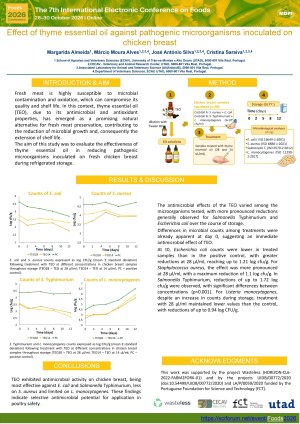
Methods: Solutions of TEO at concentrations of 28 and 14 µl/ml were prepared by diluting the TEO with Tween 80. Chicken breast pieces (25×25×5mm and 5 g) were inoculated with 5×10⁶ cfu/ml of a microbial cocktail (Cocktail A: Escherichia coli and Staphylococcus aureus; Cocktail B: Salmonella Typhimurium and Listeria monocytogenes) standardized by OD600 nm. After 15 minutes, samples were treated by direct surface application with 2 ml of each TEO solution. All samples were stored under aerobic conditions at 3 °C. Decimal dilutions were then prepared and spread-plated onto selective agar plates for enumeration on days 0, 2, 5, 8 and 12. An inoculated chicken breast piece without EO was used as control. Results were expressed as log cfu/g.
Results: Treatment with TEO showed efficacy against pathogenic microorganisms on chicken breast. At t0, Escherichia coli counts were lower in treated samples than in the positive control, with greater reductions at 28 µl/ml. For Staphylococcus aureus, no significant differences (p>0.05) were observed during storage. However, compared with the positive control, reductions of up to 1.1 log cfu/g were achieved at 28 µl/ml. In Salmonella Typhimurium, TEO at 14 µl/ml resulted in greater reductions (up to 1.72 log cfu/g at t12) than 28 µl/ml (1.44 log cfu/g), with significant differences (p<0.001) between treatments. For Listeria monocytogenes, counts increased over time, although values were lower at 28 µl/ml, with reductions against the positive control ranging from 0.77 to 0.94 log cfu/g.
Conclusions: TEO exhibited antimicrobial activity on chicken breast, being most effective against E. coli and Salmonella Typhimurium, less on S. aureus and limited on L. monocytogenes. These findings indicate selective antimicrobial potential for application in poultry safety.
Keywords
Thyme essential oil
Poultry
Food safety
Pathogenic microrganisms
Poster
EOs Poster Foods 2026 Margarida Almeida.pdf
Exploring the effect of cricket (Acheta domesticus)-enriched pasta on gut microbiota after in vitro colonic fermentation
The role of plant sterols in modulating the gut microbiota: implications for health and disease