Event submissions
Published
This submission belongs to the session B. Nutritional & Functional Foods of the event The 7th International Electronic Conference on Foods
Published date
23 Oct, 2026
Academic Editor
 Manuel Viuda-Martos
Citation
Leonardo Musto, Amparo Alegría, Guadalupe Garcia-Llatas, María Ruiz-Rico, The role of plant sterols in modulating the gut microbiota: implications for health and disease, in Proceedings of The 7th International Electronic Conference on Foods, 28 October–30 October 2026, MDPI: Basel, Switzerland
Share
Email
Facebook
Twitter
LinkedIn
The role of plant sterols in modulating the gut microbiota: implications for health and disease

Leonardo Musto 1

Amparo Alegría 1

Guadalupe Garcia-Llatas 1
María Ruiz-Rico 1
1. Nutrition and Food Science Area, Faculty of Pharmacy and Food Sciences, University of Valencia, 46100, Burjassot, Valencia, Spain
Abstract
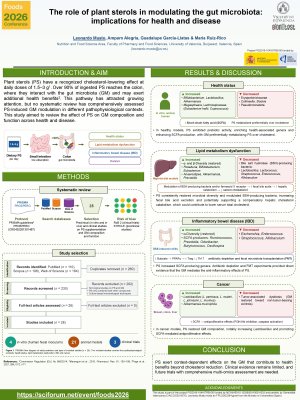
Introduction: Plant sterols (PS) have a recognized cholesterol-lowering effect at daily doses of 1.5–3 g. Over 90% of ingested PS reaches the colon, where they interact with the gut microbiota (GM) and may exert additional health benefits. This pathway has attracted growing attention, but no systematic review has comprehensively assessed PS-induced GM modulation in different pathophysiological contexts. Methodology: A systematic review was conducted following PRISMA guidelines and registered in PROSPERO (CRD420261301487). PubMed, Scopus, and Web of Science were used to search original research studies evaluating the effect of PS on GM composition and function. A total of 28 preclinical and clinical studies were included, covering four pathophysiological contexts: health status, lipid metabolism dysfunction, inflammatory bowel disease (IBD) and cancer. Risk of bias was assessed using RoB 2 for clinical trials and the SYRCLE Risk of Bias tool for preclinical studies. Results and Discussion: In healthy models, PS exhibited prebiotic activity, enriching health-associated genera and enhancing short-chain fatty acid (SCFA) production, with GM preferentially metabolising PS over cholesterol. In lipid metabolism dysfunction, PS consistently restored microbial diversity and reduced bile salt hydrolase-producing bacteria, increasing faecal excretion of bile acid and supporting a compensatory hepatic cholesterol catabolism mechanism, which ultimately contributed to a reduction in serum total cholesterol levels. In IBD models, PS increased the abundance of SCFA-producing genera, with antibiotic depletion and faecal microbiota transplantation experiments providing direct evidence that the GM mediates the PS anti-inflammatory effects. In cancer models, PS restored GM composition, notably increasing the abundance of Lactobacillus and promoting SCFA-mediated antiproliferative effects. Specific taxonomic changes and their functional implications varied according to the pathophysiological context. Conclusions: PS exert context-dependent effects on the GM that contribute to health benefits beyond cholesterol reduction. Clinical evidence remains limited, and future trials with comprehensive multi-omics assessment are needed.
Keywords
Plant sterols
gut microbiota
bile acid metabolism
cancer
colitis
Poster
POSTER STEROLS MICROBIOTA FOODS 2026.pdf
Effect of thyme essential oil against pathogenic microorganisms inoculated on chicken breast
Development and Evaluation of Soy Fiber enriched Functional Cookies by utlization of Okara