Event submissions
Published
This submission belongs to the session G. Food Safety, Toxicology & Quality of the event The 7th International Electronic Conference on Foods
Published date
23 Oct, 2026
Academic Editor
 Esther Sendra
Citation
Una Gajic, Dunja Kobiljski, Ljilja Torovic, Beyond the bar: Uncovering hazards in chocolate, in Proceedings of The 7th International Electronic Conference on Foods, 28 October–30 October 2026, MDPI: Basel, Switzerland
Share
Email
Facebook
Twitter
LinkedIn
Beyond the bar: Uncovering hazards in chocolate

Una Gajic 1
Dunja Kobiljski 2

Ljilja Torovic 1
1. Department of Pharmacy, Faculty of Medicine, University of Novi Sad, 21000 Novi Sad, Serbia
2. Department of Industrial Engineering and Management, Faculty of Technical Sciences, University of Novi Sad, Novi Sad 21000, Serbia.
Abstract
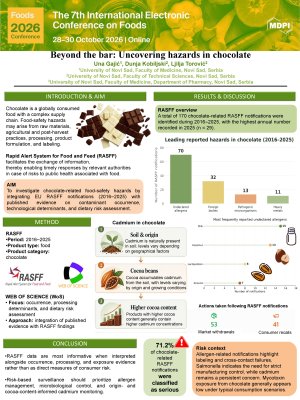
Chocolate is a globally consumed food with a complex supply chain in which safety hazards may originate from raw materials, agricultural and post-harvest practices, processing, formulation, and labeling.
This study integrated chocolate-related notifications from the European Union Rapid Alert System for Food and Feed (RASFF) for 2016–2025 with available published evidence on contaminant occurrence, technological determinants, and dietary risk assessment.
A total of 170 RASFF notifications were identified, with the highest annual number recorded in 2025 (29). Undeclared allergens predominated (70 notifications), particularly milk and tree nuts, followed by foreign bodies (32), pathogenic microorganisms (13), and heavy metals (11). Overall, 71.2% of notifications were classified as serious, meaning that the product poses a high direct or indirect threat to public health, requiring urgent cross-border action or product recalls. However, notification frequencies should not be interpreted directly as contamination prevalence or consumer risk because they are influenced by trade volumes, surveillance intensity, and regulatory priorities. Integration with published evidence revealed hazard-specific risk profiles. Mycotoxin exposure from chocolate generally remained low under typical consumption scenarios, despite recurrent occurrence of ochratoxin A and aflatoxins. In contrast, cadmium represents a more persistent concern because concentrations increase with cocoa content and are strongly influenced by the geographical origin and soil characteristics of cocoa beans; cumulative exposure to multiple metals may further increase risk among frequent consumers. Processing-related hazards are potentially more amenable to technological mitigation, whereas Salmonella prevention requires stringent control throughout manufacturing.
Overall, RASFF data are most informative when interpreted alongside trade, occurrence, processing, and exposure evidence. Risk-based surveillance should prioritize allergen management, microbiological control, origin- and cocoa-content-informed cadmium monitoring, cumulative metal exposure, and preventive interventions targeting hazards at the stages where they arise.
Keywords
public health
food safety
RASFF
Poster
Foods poster Chocolate.pdf
Hempseed oil bodies: physicochemical characterization and emerging applications in food products
A bibliometric analysis of microgreens research (2003-2025): Global agricultural and nutritional trends