Event submissions
Published
This submission belongs to the session E. Sustainable Food System & Food Security of the event The 7th International Electronic Conference on Foods
Published date
23 Oct, 2026
Academic Editor
 Arun K. Bhunia
Citation
Elisavet Kazoli, Maria Gialeli, Constantinos Giaginis, Andreas Troumbis, Georgios K. Vasios, A bibliometric analysis of microgreens research (2003-2025): Global agricultural and nutritional trends, in Proceedings of The 7th International Electronic Conference on Foods, 28 October–30 October 2026, MDPI: Basel, Switzerland
Share
Email
Facebook
Twitter
LinkedIn
A bibliometric analysis of microgreens research (2003-2025): Global agricultural and nutritional trends

Elisavet Kazoli 1
Maria Gialeli 1

Constantinos Giaginis 1

Andreas Troumbis 2

Georgios K. Vasios 1
1. Department of Food Science and Nutrition, University of the Aegean, 81400 Myrina, Lemnos, Greece
2. Department of Environment, University of the Aegean, 81100 Mytilene, Lesbos, Greece
Abstract
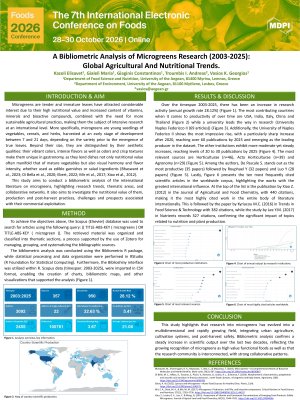
Microgreens —tender, immature vegetables harvested 7 to 21 days after planting— have gained significant popularity for their culinary appeal and exceptional nutritional value. Proposed as a new generation of functional foods, they contain significantly higher concentrations of vitamins, minerals, and bioactive compounds compared to mature vegetables. To map the growing scientific and commercial interest in this domain, this study presents a comprehensive bibliometric analysis of microgreens research from 2003 to 2025. After filtering and standardizing research retrieved from the Scopus database, a single corpus of 950 documents was used and analyzed via the Bibliometrix-R package. We evaluated research trends, collaborative networks, and central thematic areas. The findings reveal a remarkable surge in publication activity over the past decade, driven by a highly interconnected and collaborative international research community. Keyword analysis (e.g. “antioxidants”, “human”, “phytochemicals”, and “LED lighting”) highlights the inherently interdisciplinary nature of the field. Research clusters predominantly around the nutritional profiling of microgreens, potential health benefits, and innovative cultivation methods. Notably, advanced cultivation systems —such as hydroponics and aeroponics— have emerged as focal points, offering promising solutions for sustainable agriculture and food security. Finally, the study identifies critical challenges and outlines future research directions. Key priorities include the need to standardize cultivation protocols and to further explore the bioavailability and physiological health effects of the bioactive compounds found in microgreens.
Keywords
microgreens
bibliometric analysis
functional foods
nutritional value
bioactive compounds
sustainable agriculture
Poster
Foods2026 poster_Kazoli etal.pdf
Beyond the bar: Uncovering hazards in chocolate
Effect of plant sterol supplementation on oxidative stress markers in adults with obesity