Event submissions
Published
This submission belongs to the session B. Nutritional & Functional Foods of the event The 7th International Electronic Conference on Foods
Published date
23 Oct, 2026
Academic Editor
 Manuel Viuda-Martos
Citation
Leonardo Musto, Juan Francisco Merino-Torres, Dario Mercatante, Maria Teresa Rodríguez-Estrada, Amparo Alegría, Guadalupe Garcia-Llatas, Effect of plant sterol supplementation on oxidative stress markers in adults with obesity, in Proceedings of The 7th International Electronic Conference on Foods, 28 October–30 October 2026, MDPI: Basel, Switzerland
Share
Email
Facebook
Twitter
LinkedIn
Effect of plant sterol supplementation on oxidative stress markers in adults with obesity

Leonardo Musto 1
Juan Francisco Merino-Torres 2,3,4
Dario Mercatante 5
Maria Teresa Rodríguez-Estrada 5

Amparo Alegría 1

Guadalupe Garcia-Llatas 1
1. Nutrition and Food Science Area, Faculty of Pharmacy and Food Sciences, University of Valencia, 46100, Burjassot, Valencia, Spain
2. Joint Research Unit on Endocrinology, Nutrition and Clinical Dietetics, University of Valencia-Health Research Institute La Fe, 46026 Valencia, Spain
3. Department of Medicine, Faculty of Medicine, University of Valencia, 46010 Valencia, Spain
4. Department of Endocrinology and Nutrition, University and Polytechnic Hospital La Fe, 46026 Valencia, Spain
5. Department of Agricultural and Food Sciences, Alma Mater Studiorum, Università di Bologna, Viale Fanin 40, 40127, Bologna, Italy
Abstract
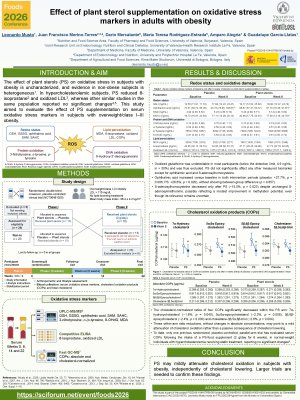
Introduction: The effect of plant sterols (PS) on oxidative stress in subjects with obesity is uncharacterized, and evidence in non-obese subjects is heterogeneous. In hypercholesterolemic subjects, PS reduced 8-isoprostane and oxidized LDL, whereas other similar studies in the same population reported no significant changes. Methodology: Randomized, double-blind, placebo-controlled crossover trial (NCT06481020) in subjects with overweight or class I–III obesity and mild hypercholesterolemia (BMI: 36.4 ± 4.2 kg/m²; LDL > 115 mg/dL; n=23). Participants received 2 g/day PS or placebo for 8 weeks (6-week washout). Reduced and oxidized glutathione, ophthalmic acid, S-adenosylhomocysteine, S-adenosylmethionine, 3-nitrotyrosine, o-tyrosine, p-tyrosine, 8-hydroxy-2′-deoxyguanosine, malondialdehyde, 8-isoprostane, oxidized LDL, and cholesterol oxidation products (COPs), absolute and cholesterol-normalized, were quantified in serum before and after each treatment. Results and Discussion: Oxidized glutathione was undetectable in most participants (below the detection limit, 4.9 ng/mL, in >50%) and excluded. PS did not significantly affect any measured biomarker except the following. Ophthalmic acid increased versus baseline in both periods (placebo: +27.7%, p=0.006; PS: +26.6%, p=0.020), without between-group difference (p=0.857). S-adenosylhomocysteine decreased only after PS (−15.5%, p=0.023) despite unchanged S-adenosylmethionine, possibly reflecting a modest improvement in methylation potential, though the relevance of this isolated change remains uncertain. The cholesterol-normalized ratios of four COPs significantly decreased after PS: 7α-hydroxycholesterol (−1.8%, p=0.040), 5α,6α-epoxycholesterol (−2.3%, p=0.008), 5β,6β-epoxycholesterol (−2.4%, p=0.030), and cholestane-3β,5α,6β-triol (−2.6%, p=0.004). These ratio reductions, but not in absolute concentrations, indicate an active antioxidant effect rather than a passive consequence of cholesterol lowering, which would otherwise have reduced absolute COPs in parallel. Conclusions: PS may exert a mild but specific antioxidant effect on cholesterol oxidation in subjects with obesity, independently of cholesterol lowering. Although COPs are biologically relevant oxidative species, the reduction was small and its clinical significance is uncertain. Larger trials are needed to confirm these findings.
Keywords
Plant sterols
oxidative stress
clinical trial
obesity
Poster
POSTER STEROLS OXIDATIVE STRESS FOODS 2026.pdf
A bibliometric analysis of microgreens research (2003-2025): Global agricultural and nutritional trends
Microplastic Contamination of Honey: A Systematic Review of Occurrence, Sources, and Bee Health Effects