Event submissions
Published
This submission belongs to the session G. Food Safety, Toxicology & Quality of the event The 7th International Electronic Conference on Foods
Published date
23 Oct, 2026
Academic Editor
 Esther Sendra
Citation
Vlatka Mikulec, Želimira Cvetković, Petra Besedić, Martina Ivešić, Microplastic Contamination of Honey: A Systematic Review of Occurrence, Sources, and Bee Health Effects, in Proceedings of The 7th International Electronic Conference on Foods, 28 October–30 October 2026, MDPI: Basel, Switzerland
Share
Email
Facebook
Twitter
LinkedIn
Microplastic Contamination of Honey: A Systematic Review of Occurrence, Sources, and Bee Health Effects

Vlatka Mikulec 1
Želimira Cvetković 1
Petra Besedić 2
Martina Ivešić 1
1. Andrija Stampar Teaching Institute of Public Health, Mirogojska cesta 16, 10000 Zagreb, Croatia
2. Faculty of Mechanical Engineering and Naval Architecture, University of Zagreb, Ivana Lučića 5, 10000 Zagreb, Croatia
Abstract
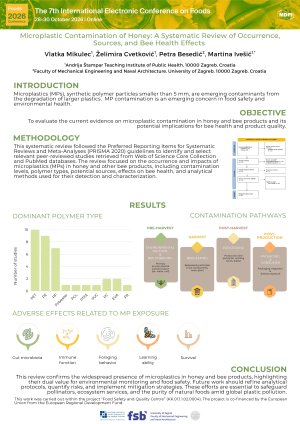
Microplastics (MPs), synthetic polymer particles smaller than 5 mm, are emerging contaminants from the degradation of larger plastics. These particles infiltrate terrestrial ecosystems through soil, air, water, nectar, pollen, and resins, entering food chains. Honeybees (Apis mellifera), with their extensive foraging ranges and direct interactions with multiple environmental compartments, serve as effective bioindicators of pollution. Consequently, the accumulation of MPs in hive products such as honey, pollen, and propolis jeopardizes beekeeping sustainability and poses potential dietary risks to human consumers. This review examined peer-reviewed studies on MPs occurrence and impacts in honey and bee products, focusing on contamination levels, polymer types, sources, bee health effects, and analytical techniques. Studies from Europe, Asia, and South America report MPs contamination in honey, with levels ranging from tens to over 1,000–2,600 particles per kg or L. Dominant polymers include polypropylene, polyethylene, polyethylene terephthalate, nylon, and ethylene-vinyl acetate. Pathways involve atmospheric deposition during foraging, alongside beekeeping practices and processing. Advances in Fourier-transform infrared (FTIR) and Raman microspectroscopy have improved detection reliability. MPs exposure disrupts honeybees gut microbiota, immune function, foraging behavior, learning ability, and survival, potentially synergizing with other stressors. Honey thus serves as an environmental sentinel for terrestrial MPs pollution and a potential low-level route of human exposure. Regional and methodological variations emphasize the need for standardization, including gaps in source apportionment, temporal trends, and long-term risk assessment. This review confirms the widespread presence of microplastics in honey and bee products, highlighting their dual value for environmental monitoring and food safety. Future work should refine analytical protocols, quantify risks, and implement mitigation strategies. These efforts are essential to protect vital ecosystem services and ensure the purity of natural foods in the face of global plastic pollution.
Acknowledgement:This work was carried out within the project "Food Safety and Quality Center" (KK.01.1.1.02.0004).
Keywords
microplastics
food safety
honey bees
bioindicators
environmental monitoring
Poster
FOODS 2026 VM.pdf
Effect of plant sterol supplementation on oxidative stress markers in adults with obesity
Antifungal and Anti-mycotoxigenic Potential of Lachancea thermotolerans ST12 and Starmerella sp. CMGB-ST8.2 against Aspergillus ochraceus for Biocontrol Applications