Event submissions
Published
This submission belongs to the session B. Nutritional & Functional Foods of the event The 7th International Electronic Conference on Foods
Published date
23 Oct, 2026
Academic Editor
 Manuel Viuda-Martos
Citation
Rosana Aparecida Manolio Soares-Freitas, Bianka Caliman Salvador, Amanda C.C.C. Carlos, Daniel C. Pimenta, Liania Alves Luzia, José Alfredo Gomes Arêas, Identification of Circulating Peptides In Vivo Following Amaranth Protein Isolate Ingestion, in Proceedings of The 7th International Electronic Conference on Foods, 28 October–30 October 2026, MDPI: Basel, Switzerland
Share
Email
Facebook
Twitter
LinkedIn
Identification of Circulating Peptides In Vivo Following Amaranth Protein Isolate Ingestion

Rosana Aparecida Manolio Soares-Freitas 1
Bianka Caliman Salvador 1
Amanda C.C.C. Carlos 1
Daniel C. Pimenta 2
Liania Alves Luzia 1
José Alfredo Gomes Arêas 1
1. Department of Nutrition, School of Public Health, University of São Paulo, São Paulo, 01246-904, Brazil
2. Biochemical and Biophysics Laboratory, Butantan Institute, São Paulo, 05503-900 - Brazil.
Abstract
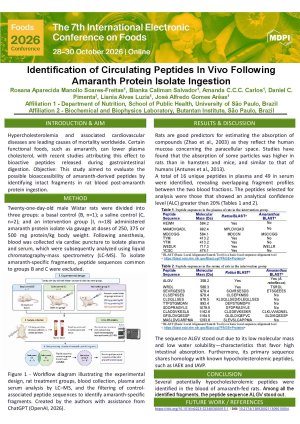
Introduction: Hypercholesterolemia and associated cardiovascular diseases are leading causes of mortality worldwide. Certain functional foods, such as amaranth, can lower plasma cholesterol, with recent studies attributing this effect to bioactive peptides released during gastrointestinal digestion. Objective: This study aimed to evaluate the bioaccessibility of amaranth-derived peptides by identifying intact protein fragments in rat blood post-digestion. Methods: Twenty-one-day-old male Wistar rats were divided into three groups: a basal control (B, n=1); a saline control (C, n=2); and an intervention group (I, n=18) administered amaranth protein isolate via gavage at doses of 250, 375 or 500 mg protein/kg body weight. Following anesthesia, blood was collected via cardiac puncture to isolate plasma and serum, which were subsequently analyzed using liquid chromatography-mass spectrometry (LC-MS). To isolate amaranth-specific fragments, peptide sequences common to groups B and C were excluded. Results: Consequently, 16 unique peptides in plasma and 49 in serum were identified, revealing overlapping fragment profiles between the two blood fractions. Notably, the sequence ALGV stood out due to its low molecular mass and low water solubility—characteristics that favor high intestinal absorption. Furthermore, its primary sequence shares homology with known hypocholesterolemic peptides, such as IAEK and IAVP. Conclusion: Several potentially hypocholesterolemic peptides were identified in the blood of amaranth-fed rats, warranting further in silico and in vitro evaluation.
Keywords
Amaranthus cruentus
circulating peptides
rats
LC-MS analysis
Poster
Foods_poster_Soares-Freitas.pdf
Antifungal and Anti-mycotoxigenic Potential of Lachancea thermotolerans ST12 and Starmerella sp. CMGB-ST8.2 against Aspergillus ochraceus for Biocontrol Applications
Formulation and Quality Optimization of a Goat Whey-Milk Kefir Enriched with Powdered Milk