Event submissions
Published
This submission belongs to the session G. Food Safety, Toxicology & Quality of the event The 7th International Electronic Conference on Foods
Published date
23 Oct, 2026
Academic Editor
 Esther Sendra
Citation
Khadidja Reguieg, Vasco Cadavez, Ursula Gonzales-Barron, Formulation and Quality Optimization of a Goat Whey-Milk Kefir Enriched with Powdered Milk, in Proceedings of The 7th International Electronic Conference on Foods, 28 October–30 October 2026, MDPI: Basel, Switzerland
Share
Email
Facebook
Twitter
LinkedIn
Formulation and Quality Optimization of a Goat Whey-Milk Kefir Enriched with Powdered Milk

Khadidja Reguieg 1
Vasco Cadavez 1

Ursula Gonzales-Barron 1
1. Associate Laboratory for Sustainability and Technology in Mountains Regions (SusTEC), Polytechnic Institute of Braganza, Campus de Santa Apolonia 5300-253, Braganza, Portugal
Abstract
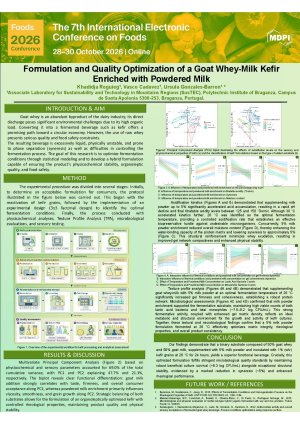
Introduction: Whey is a by-product of the dairy industry. It can be processed into kefir, but kefir made solely from whey has a very liquid consistency that is not popular with consumers. The objective of this study was to improve the excessively liquid consistency of pure whey kefir by developing new hybrid formulations using powdered milk and goat’s milk.
Methods: To improve the consistency of the kefir produced, different concentrations of goat’s milk and powdered milk were first tested. Based on sensory and textural optimization from these preliminary trials, a standardized hybrid formulation containing 50% goat whey and 50% goat’s milk was selected. This matrix was enriched with different concentrations of powdered milk (0%, 2.5%, and 5%) and fermented at three incubation temperatures (22 °C, 26 °C, and 30 °C) for 24 h using an inoculum of 1% (w/v) kefir grains. Principal Component Analysis (PCA) was applied to analyze multivariate correlations between sensory, physicochemical, and textural attributes and to classify the formulations. Additionally, analysis of variance (ANOVA) and linear regressions were employed to assess the direct and interactive effects of incubation temperature and powdered milk concentration on specific physicochemical, microbiological, and textural properties.
Results: Goat’s milk maximizes sensory acceptability (taste, appearance), while powdered milk improves the instrumental index of viscosity and sensory smoothness. Enrichment with 5% powdered milk exhibited temperature-dependent pH stabilization under thermal stress at 30 °C, limiting the pH drop to 25% compared to 34% in the control (0% powdered milk). This formulation reduced syneresis and promoted lactic acid bacteria (8.39 log CFU/mL) and mesophilic bacteria (8.65 log CFU/mL) proliferation at 26 °C, compared to 7.67 and 8.27 log CFU/mL in the control.
Conclusion: Enriching the hybrid matrix with 5% powdered milk and fermenting it at a constant temperature of 26 °C results in the optimal formulation, with favorable physicochemical, microbiological, and sensory characteristics under the conditions tested.
Keywords
Kefir
Whey
Kefir grain
fermentation
Sensory analysis
Principal Component Analysis
Optimization
Poster
Foods poster KhadidjaReguieg2026.pdf
Identification of Circulating Peptides In Vivo Following Amaranth Protein Isolate Ingestion
Future Food as an Optimization Problem: Balancing Nutrition, Sustainability, Justice, and Agency