Event submissions
Published
This submission belongs to the session B. Nutritional & Functional Foods of the event The 7th International Electronic Conference on Foods
Published date
23 Oct, 2026
Academic Editor
 Manuel Viuda-Martos
Citation
Leonardo Musto, Juan Francisco Merino-Torres, Amparo Alegría, Guadalupe Garcia-Llatas, Plant sterol supplementation does not inhibit intestinal cholesterol absorption in subjects with obesity, in Proceedings of The 7th International Electronic Conference on Foods, 28 October–30 October 2026, MDPI: Basel, Switzerland
Share
Email
Facebook
Twitter
LinkedIn
Plant sterol supplementation does not inhibit intestinal cholesterol absorption in subjects with obesity

Leonardo Musto 1
Juan Francisco Merino-Torres 2,3,4

Amparo Alegría 1

Guadalupe Garcia-Llatas 1
1. Nutrition and Food Science Area, Faculty of Pharmacy and Food Sciences, University of Valencia, 46100, Burjassot, Valencia, Spain
2. Joint Research Unit on Endocrinology, Nutrition and Clinical Dietetics, University of Valencia-Health Research Institute La Fe, 46026 Valencia, Spain
3. Department of Medicine, Faculty of Medicine, University of Valencia, 46010 Valencia, Spain
4. Department of Endocrinology and Nutrition, University and Polytechnic Hospital La Fe,
46026 Valencia, Spain
Abstract
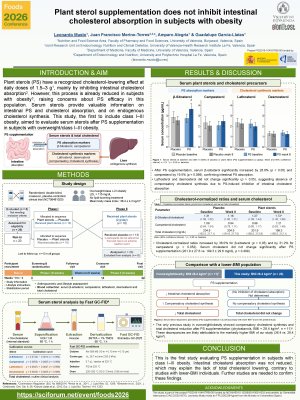
Introduction: Plant sterols (PS) have a recognized cholesterol-lowering effect at daily doses of 1.5–3 g, but their effects in subjects with obesity remain scarcely studied. PS mainly lower cholesterol by inhibiting intestinal absorption; however, this process is already reduced in subjects with obesity, raising concerns about PS efficacy in this population. Serum sterols provide valuable information on intestinal PS and cholesterol absorption, and on endogenous cholesterol synthesis. Only one study has measured serum sterols in overweight/obesity individuals after PS supplementation (phytostanols, BMI=28.4 kg/m², n=11). Methodology: Randomized, double-blind, placebo-controlled, crossover clinical trial was conducted in 23 subjects with overweight/class I–III obesity and mild hypercholesterolemia (LDL>115 mg/dL) (NCT06481020). Participants received 2 g/day of PS or placebo for 8 weeks (6-week washout). Serum β-sitosterol, campesterol (PS absorption markers), lathosterol and desmosterol (cholesterol synthesis markers) were quantified at baseline and after each treatment. Results and Discussion: After PS supplementation, serum β-sitosterol significantly increased by 28.8% (absolute) and 36.0% (cholesterol-normalized ratio) (p<0.05), and campesterol by 19.5% and 31.2% (p=0.098 and p=0.0522), confirming intestinal absorption. Lathosterol and desmosterol did not change significantly (p>0.05), indicating the absence of compensatory cholesterol synthesis due to PS-induced inhibition of intestinal cholesterol absorption. This is consistent with the non-significant changes in serum cholesterol after PS supplementation (201.9 ± 27.6 vs. 199.3 ± 29.6 mg/dL, p= 0.499). In contrast, the previous study in overweight/obesity showed compensatory cholesterol synthesis and total cholesterol reduction after PS supplementation. These discrepancies are likely attributable to the markedly higher BMI of our study (36.4 vs. 28.4 kg/m²). Conclusions: This is the first study evaluating PS supplementation in subjects with obesity class I–III. Cholesterol intestinal absorption was not reduced, explaining the lack of total cholesterol lowering, contrary to studies with lower-BMI individuals. Further studies are needed to confirm these findings.
Keywords
plant sterols
obesity
clinical trial
cholesterol metabolism
Poster
POSTER SERUM STEROLS FOODS 2026.pdf
Future Food as an Optimization Problem: Balancing Nutrition, Sustainability, Justice, and Agency
Probiotics and Fermentation-Derived Metabolites: Advances in Functional Food Science