Event submissions
Published
This submission belongs to the session B. Nutritional & Functional Foods of the event The 7th International Electronic Conference on Foods
Published date
23 Oct, 2026
Academic Editor
 Manuel Viuda-Martos
Citation
Irene Dini, Probiotics and Fermentation-Derived Metabolites: Advances in Functional Food Science, in Proceedings of The 7th International Electronic Conference on Foods, 28 October–30 October 2026, MDPI: Basel, Switzerland
Share
Email
Facebook
Twitter
LinkedIn
Probiotics and Fermentation-Derived Metabolites: Advances in Functional Food Science

Irene Dini 1
1. Pharmacy Department- Federico II University of Naples, Naples, 80131, Italy
Abstract
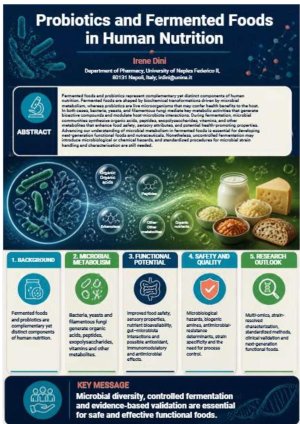
Fermented foods and probiotics represent two interconnected yet distinct pillars of functional nutrition, both driven by microbial metabolism and the generation of health‑relevant metabolites. Fermented foods rely on complex microbial consortia, comprising lactic acid bacteria, acetic acid bacteria, yeasts, and filamentous fungi, that transform raw matrices through enzymatic activities, producing organic acids, bioactive peptides, vitamins, exopolysaccharides, and postbiotic compounds. These metabolites contribute to improved sensory properties, extended shelf life, enhanced nutrient bioavailability, and the reduction of antinutritional factors, mycotoxins, and pesticide residues. Probiotics, in contrast, require strain‑specific characterization, documented safety, and evidence‑based health benefits, distinguishing them from the broader and more variable microbial communities found in traditional fermented foods. Recent advances in multi‑omics technologies have deepened our understanding of microbial interactions, metabolic pathways, and the formation of functional metabolites during fermentation. These insights support the development of precision‑fermented foods and targeted probiotic formulations capable of modulating gut microbiota, strengthening epithelial integrity, and influencing key physiological pathways involved in oxidative stress, inflammation, and metabolic regulation. Despite these promising outcomes, safety considerations remain essential. Fermentation processes may introduce microbiological hazards, biogenic amines, or antimicrobial resistance determinants if not properly controlled, highlighting the need for standardized production, rigorous microbial monitoring, and risk assessment. In any case, the integration of traditional fermentation practices with modern microbial biotechnology offers a powerful strategy for designing next‑generation functional foods. By combining sustainable biotransformation, controlled microbial ecology, and clinically validated probiotic strains, it is possible to develop food products that deliver reproducible, safe, and scientifically supported health benefits.
Keywords
Probiotics
Fermented foods
Bioactive metabolites
Postbiotics
Food safety
Antinutritional factors
Functional nutrition
Fermentation-derived compounds
Poster
poster.pdf
Plant sterol supplementation does not inhibit intestinal cholesterol absorption in subjects with obesity
qPCR-HRM Authentication of Single-Component Dominant Functional Foods