Event submissions
Published
This submission belongs to the session E. Sustainable Food System & Food Security of the event The 7th International Electronic Conference on Foods
Published date
23 Oct, 2026
Academic Editor
 José Ángel Pérez-Álvarez
Citation
María Eugenia Golzi, Lucas Marchetti, Gabriel Lorenzo, Technological properties and optimization of lentil aquafaba for the development of vegan meringues, in Proceedings of The 7th International Electronic Conference on Foods, 28 October–30 October 2026, MDPI: Basel, Switzerland
Share
Email
Facebook
Twitter
LinkedIn
Technological properties and optimization of lentil aquafaba for the development of vegan meringues

María Eugenia Golzi 1,2
Lucas Marchetti 1
Gabriel Lorenzo 1,3
1. Research Laboratory in Hydrocolloids and Healthy Food Matrices (LIHMAS), Research and Development Center in Food Science and Technology (CIDCA), CONICET, CICPBA, Faculty of Exact Sciences, National University of La Plata (UNLP), La Plata 1900, Buenos Aires, Argentina.
2. Department of Chemical Engineering, Higher Polytechnic School, University of Seville, Seville 41011, Spain.
3. Department of Chemical Engineering, Faculty of Engineering, National University of La Plata (UNLP), La Plata 1900, Buenos Aires, Argentina.
Abstract
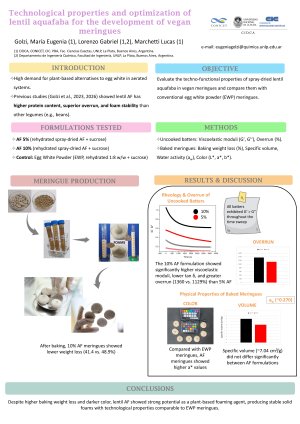
Demand for plant-based food alternatives has driven the search for sustainable egg white substitutes. Aquafaba (AF), the cooking wastewater of legumes, presents excellent foaming properties due to its proteins, carbohydrates, and saponins. Compared to other legumes such as beans, lentil AF offers higher protein content, overrun, and foam stability, making it a promising candidate for aerated systems. This study aimed to evaluate the techno-functional properties of spray-dried lentil AF and its application in vegan meringues compared with conventional egg white meringues.
AF was obtained by soaking and boiling dry lentils (Lens culinaris var. variabilis), followed by spray drying. Based on preliminary screening assays and optimal foam stability ranges reported in the literature, meringue batters were prepared by whipping rehydrated AF at 5 and 10% (g/100 g) with sucrose. Small-amplitude oscillatory shear tests included amplitude sweeps to determine the linear viscoelastic region (LVR) and 60-min time sweeps within the LVR to monitor G′, G″, and tan δ. Overrun was also determined. Baked meringues (100 °C, 120 min) were characterized by baking weight loss, specific volume, water activity (aw), and CIELAB color (L*, a*, b*). Rehydrated egg white powder (EWP, 1:8) was used as reference. Data were analyzed by one-way ANOVA and Tukey’s test (p < 0.05).
All batters exhibited G′ > G″ throughout the time sweep. The 10% AF formulation showed significantly higher viscoelastic moduli, lower tan δ, and greater overrun (1360 vs. 1129%) than 5% AF. After an initial decrease, both moduli approached asymptotic values, although 5% AF showed a smaller relative decrease over time. After baking, 10% AF meringues showed lower weight loss (41.4 vs. 48.9%), while specific volume (~7.04 cm³/g) and aw (~0.270) did not differ significantly between AF formulations. Compared with EWP meringues, AF meringues showed higher a* values, higher baking weight loss (EWP: 27.9%), comparable specific volume, and slightly lower aw (EWP: 0.314).
Despite higher baking weight loss and darker color, lentil AF showed strong potential as a plant-based foaming agent, producing stable solid foams with technological properties comparable to EWP meringues.
Keywords
Aquafaba
Lentil
Meringues
Rheology
Poster
Sciforum-198653 María Eugenia Golzi.pdf
qPCR-HRM Authentication of Single-Component Dominant Functional Foods
Evaluation of Sulfite-Free Anti-Browning Pretreatments on Moisture Content of Osmotically-Dehydrated Philippine Carabao Mango (Mangifera indica L.) Slices During Cabinet Drying