Event submissions
Published
This submission belongs to the session G. Food Safety, Toxicology & Quality of the event The 7th International Electronic Conference on Foods
Published date
23 Oct, 2026
Academic Editor
 Esther Sendra
Citation
Guiller Dartin L. Canapi, Ezra Gabrielle J. Cacayan, Gina B. Abrera, Ma. Patricia V. Azanza, Custer C. Deocaris, Gerieka R. Anapi, Evaluation of Sulfite-Free Anti-Browning Pretreatments on Moisture Content of Osmotically-Dehydrated Philippine Carabao Mango (Mangifera indica L.) Slices During Cabinet Drying, in Proceedings of The 7th International Electronic Conference on Foods, 28 October–30 October 2026, MDPI: Basel, Switzerland
Share
Email
Facebook
Twitter
LinkedIn
Evaluation of Sulfite-Free Anti-Browning Pretreatments on Moisture Content of Osmotically-Dehydrated Philippine Carabao Mango (Mangifera indica L.) Slices During Cabinet Drying

Guiller Dartin L. Canapi 1
Ezra Gabrielle J. Cacayan 1
Gina B. Abrera 1
Ma. Patricia V. Azanza 1
Custer C. Deocaris 1

Gerieka R. Anapi 2
1. Biomedical Research Section, Atomic Research Division, Philippine Nuclear Research Institute, Department of Science and Technology, Quezon City, Philippines.
2. Department of Food Science and Nutrition, College of Home Economics, University of the Philippines Diliman, Quezon City, Philippines.
Abstract
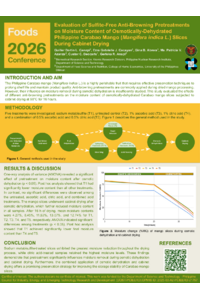
The Philippine Carabao mango (Mangifera indica L. cv. Carabao) is a highly perishable fruit that requires effective preservation techniques to prolong shelf life and maintain product quality. Anti-browning pretreatments are commonly applied during dried mango processing. However, their influence on moisture removal during osmotic dehydration is insufficiently studied. This study evaluated the effects of different anti-browning pretreatments on the moisture content of osmotically dehydrated Carabao mango slices subjected to cabinet drying at 60°C for 16 hours. Five treatments were investigated: sodium metabisulfite (T1), untreated control (T2), 1% ascorbic acid (T3), 1% citric acid (T4), and a combination of 0.5% ascorbic acid and 0.5% citric acid (T5). Following osmotic dehydration, moisture contents ranged from 62.05% to 75.23%. One-way analysis of variance (ANOVA) revealed a significant effect of pretreatment on moisture content after osmotic dehydration (p < 0.05). Post hoc analysis showed that T1 had significantly lower moisture content than all other treatments. In contrast, no significant differences were observed among the untreated, ascorbic acid, citric acid, and combined acid treatments. The mango slices underwent cabinet drying after osmotic dehydration, which further reduced moisture content in all samples. After 16 h of drying, mean moisture contents were 4.27%, 8.45%, 11.53%, 13.07%, and 12.74% for T1, T2, T3, T4, and T5, respectively. ANOVA indicated significant differences among treatments (p < 0.05). Post hoc analysis showed that T1 achieved significantly lower final moisture content than T4 and T5. Sodium metabisulfite-treated slices exhibited the greatest moisture reduction throughout the drying process, while citric acid-treated samples retained the highest moisture levels. These findings demonstrate that pretreatment significantly influences moisture removal during osmotic dehydration and cabinet drying. Furthermore, the combined application of osmotic dehydration and cabinet drying offers a promising preservation strategy for improving the storage stability of Carabao mango slices.
Keywords
Philippine Carabao mango (Mangifera indica L.)
sodium metabisulfite,
ascorbic acid
citric acid
osmotic dehydration
cabinet drying
moisture content
Poster
Foods 2026_Canapi et al.pdf
Technological properties and optimization of lentil aquafaba for the development of vegan meringues
Simultaneous voltammetric method for quality control of brilliant blue FCF and tartrazine in beverages