Event submissions
Published
This submission belongs to the session B. Nutritional & Functional Foods of the event The 7th International Electronic Conference on Foods
Published date
23 Oct, 2026
Academic Editor
 Manuel Viuda-Martos
Citation
Denise Grimaut, Mariana Soledad Lingua, Roxana Páez, Jesica Blajman, María Verónica Baroni, Multifunctional cream cheese enriched with co-encapsulated polyphenols from sweet potato waste and probiotics, in Proceedings of The 7th International Electronic Conference on Foods, 28 October–30 October 2026, MDPI: Basel, Switzerland
Share
Email
Facebook
Twitter
LinkedIn
Multifunctional cream cheese enriched with co-encapsulated polyphenols from sweet potato waste and probiotics

Denise Grimaut 1
Mariana Soledad Lingua 1
Roxana Páez 1
Jesica Blajman 1
María Verónica Baroni 2,3
1. Dairy Chain Research Institute, (IdICaL, CONICET-INTA), Santa Fe, CP 2300 Rafaela, Argentina
2. Instituto de Ciencia y Tecnología de Alimentos Córdoba (ICYTAC)- UNC/ CONICET, Juan Filloy S/N, Ciudad Universitaria, Córdoba, CP 5000, Argentina
3. Departamento Química Orgánica, Facultad de Ciencias Químicas, Universidad Nacional de Córdoba (UNC), Medina Allende y Haya de la Torre, Ciudad Universitaria, Córdoba, CP 5000, Argentina
Abstract
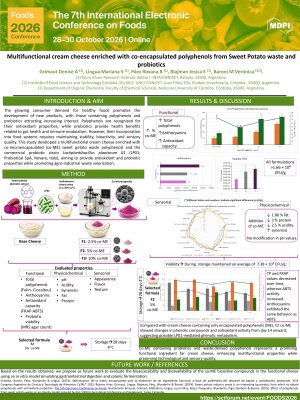
Growing consumer demand for healthy foods has increased interest in products containing polyphenols and probiotics. Polyphenols are recognized for their antioxidant properties, while probiotics provide benefits related to gut health and immune modulation. However, their incorporation into food systems requires maintaining stability, bioactivity, and sensory quality. This study developed a multifunctional cream cheese enriched with co-microencapsulated (co-ME) sweet potato waste polyphenols and the commercial probiotic strain Lactiplantibacillus plantarum 01 (LP01; Probiotical SpA, Novara, Italy), aiming to provide antioxidant and probiotic properties while promoting agro-industrial waste valorization. Cream cheese formulations containing 2.5% (F1), 5% (F2), and 10% (F3) (w/w) co-ME were prepared. Microcapsules were obtained by spray drying sweet potato waste phenolic extract and LP01 using a maltodextrin:cheese whey (1:1; 20% w/v) carrier system. Functional (total polyphenols, anthocyanins, antioxidant capacity by FRAP and ABTS, and probiotic viability), physicochemical (pH, acidity, syneresis, fat, and protein), and sensory properties were evaluated. The selected formulation was further monitored during 28 days of storage at 4 °C. In all studies, formulations were compared with a control cream cheese (without co-ME). All formulations met probiotic requirements (>1.66 × 10⁸ CFU/g). Total polyphenols, anthocyanins, and antioxidant capacity increased with co-ME concentration. Co-ME reduced acidity, fat, and protein contents and increased syneresis, without affecting pH. Sensory analysis identified F2 as the most acceptable formulation, closely resembling the control cheese. During storage, F2 maintained probiotic viability above the recommended level (7.38 × 10⁷ CFU/g average). Total phenolics, anthocyanins, and FRAP values decreased over time, whereas ABTS activity increased. Compared with cream cheese containing only encapsulated polyphenols, F2 showed changes in phenolic compounds and antioxidant activity from day 14 onward, suggesting possible LP01-mediated phenolic metabolism. Co-ME containing probiotics and waste-derived polyphenols represents a promising functional ingredient for cream cheese, enhancing multifunctional properties while preserving technological and sensory quality.
Keywords
valorization
food by-product
antioxidant capacity
bioactive food ingredient
dairy product
Poster
Grimaut final 2026FEC.pdf
Simultaneous voltammetric method for quality control of brilliant blue FCF and tartrazine in beverages
Redefining Salmonella spp. challenge testing in Ready to eat (RTE) products: current gaps and harmonisation proposal