Event submissions
Published
This submission belongs to the session B. Nutritional & Functional Foods of the event The 7th International Electronic Conference on Foods
Published date
23 Oct, 2026
Academic Editor
 Manuel Viuda-Martos
Citation
Leonardo Musto, Juan Francisco Merino-Torres, Amparo Alegría, Guadalupe Garcia-Llatas, Management of chronic low-grade inflammation through plant sterol supplementation: A randomized trial in subjects with obesity, in Proceedings of The 7th International Electronic Conference on Foods, 28 October–30 October 2026, MDPI: Basel, Switzerland
Share
Email
Facebook
Twitter
LinkedIn
Management of chronic low-grade inflammation through plant sterol supplementation: A randomized trial in subjects with obesity

Leonardo Musto 1
Juan Francisco Merino-Torres 2,3,4

Amparo Alegría 1

Guadalupe Garcia-Llatas 1
1. Nutrition and Food Science Area, Faculty of Pharmacy and Food Sciences, University of Valencia, 46100, Burjassot, Valencia, Spain
2. Joint Research Unit on Endocrinology, Nutrition and Clinical Dietetics, University of Valencia-Health Research Institute La Fe, 46026 Valencia, Spain
3. Department of Medicine, Faculty of Medicine, University of Valencia, 46010 Valencia, Spain
4. Department of Endocrinology and Nutrition, University and Polytechnic Hospital La Fe, 46026 Valencia, Spain
Abstract
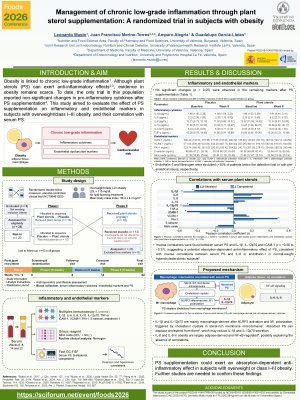
Introduction: Obesity is linked to chronic low-grade inflammation. Although plant sterols (PS) can exert anti-inflammatory effects, evidence in obesity remains scarce. To date, the only trial in this population reported non-significant changes in pro-inflammatory cytokines after PS supplementation. Methodology: A randomized, double-blind, placebo-controlled crossover trial included 23 subjects with overweight/class I–III obesity (BMI: 36.4 ± 4.2 kg/m²) and mild hypercholesterolemia (LDL > 115 mg/dL) (NCT06481020). Participants received 2 g/day of PS or placebo for 8 weeks (6-week washout). Inflammatory cytokines (IL-1β, IL-6, IL-8, IL-10, IL-12p70, TNF-α) and endothelial markers (ICAM-1, VCAM-1, E-selectin, endothelin-1, PAI-1, nitric oxide, fibrinogen) were measured in serum at baseline and after each treatment. Pearson and Spearman correlations with serum PS were computed. Results and Discussion: Endothelin-1 and fibrinogen were excluded (>30% of patients below the detection limit or with pre-analytical issues, respectively). No significant changes (p > 0.05) were observed in the remaining markers after PS supplementation. However, substantial inverse correlations were found between serum PS and IL-1β, IL-12p70 and ICAM-1 (r = ‒0.56 to ‒0.37). These findings support an absorption-dependent anti-inflammatory effect of PS, consistent with inverse correlations between serum PS and IL-6 or endothelin-1 reported in normal-weight hypercholesterolemic subjects. IL-1β and IL-12p70 are mainly macrophage-derived following NLRP3 inflammasome activation and M1 polarization, processes linked to intracellular cholesterol handling and triggered by cholesterol crystals forming in sterol-rich membrane microdomains. Once absorbed, PS can incorporate into macrophage membranes, modifying these microdomains by displacing cholesterol, which may reduce IL-1β and IL-12p70 secretion. In contrast, IL-6 and IL-8 in obesity are largely adipose-tissue-derived and NF-κB-regulated, possibly explaining the absence of correlations for these cytokines. Conclusions: PS supplementation could exert an absorption-dependent anti-inflammatory effect in subjects with overweight or class I–III obesity. Further studies are needed to confirm these findings.
Keywords
Plant sterols
chronic low-grade inflammation
randomized trial
obesity
Poster
POSTER STEROLS INFLAMMATION FOODS 2026.pdf
Redefining Salmonella spp. challenge testing in Ready to eat (RTE) products: current gaps and harmonisation proposal
Quality and Microbiological Stability of Pasteurized Coconut Skim Milk During Refrigerated Storage