Event submissions
Published
This submission belongs to the session G. Food Safety, Toxicology & Quality of the event The 7th International Electronic Conference on Foods
Published date
23 Oct, 2026
Academic Editor
 Esther Sendra
Citation
Erwin Limbo Descallar, Restituto Tocmo, Jin Mark Pagulayan, Casiana Blanca Jucar Villarino, Quality and Microbiological Stability of Pasteurized Coconut Skim Milk During Refrigerated Storage, in Proceedings of The 7th International Electronic Conference on Foods, 28 October–30 October 2026, MDPI: Basel, Switzerland
Share
Email
Facebook
Twitter
LinkedIn
Quality and Microbiological Stability of Pasteurized Coconut Skim Milk During Refrigerated Storage

Erwin Limbo Descallar 1,2
Restituto Tocmo 3

Jin Mark Pagulayan 2

Casiana Blanca Jucar Villarino 2
1. Department of Food Technology, Polytechnic University of the Philippines, Manila, Philippines.
2. College of Home Economics, University of the Philippines Diliman, Quezon City, Philippines.
3. Department of Food and Nutritional Sciences, University of Reading, Reading, United Kingdom.
Abstract
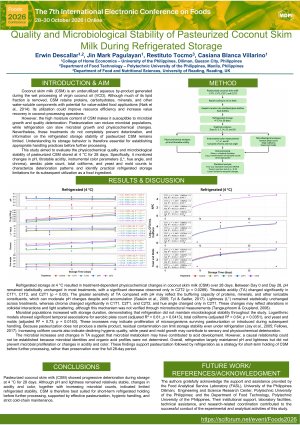
Coconut skim milk (CSM), a high-moisture by-product of wet centrifugation-based virgin coconut oil processing, requires appropriate post-pasteurization storage to maintain its quality and microbiological safety for further food utilization. This study evaluated the stability of pasteurized CSM under refrigerated storage at 4 °C over 28 days, focusing on physicochemical, color, and microbiological changes. Pasteurized CSM treatments (e.g C1T1=70°C at 5mins; C1T2=70°C at 10mins; C2T1= 80°C at 5mins; C2T2 = 80°C at 10mins) were monitored for pH, titratable acidity, L* value, hue angle, chroma, aerobic plate count, total coliforms, and yeast and molds. Results showed that pH remained relatively stable during refrigerated storage, with no significant Day 0–Day 28 changes in most treatments, except C2T2, which showed a significant decrease (p < 0.05). In contrast, titratable acidity significantly increased in C1T1, C1T2, and C2T1 (p < 0.05), indicating progressive acid development despite limited pH variation. Color changes were also observed, particularly in chroma, which significantly changed in C1T1, C2T1, and C2T2 (p < 0.05). Microbiological results further showed significant logarithmic increases in aerobic plate count, total coliforms, and yeast and molds during storage. Refrigerated pasteurized CSM remained relatively safe up to Day 7, after which microbial increases indicated progressive deterioration. Overall, refrigeration slowed but did not prevent quality loss, supporting only short-term refrigerated storage or the need for further preservation.
Keywords
Coconut Skim Milk
Storage Stability
Microbial Safety
Valorization
Poster
Coconut Skim Milk.pdf
Management of chronic low-grade inflammation through plant sterol supplementation: A randomized trial in subjects with obesity
From Bovine Bone Waste to Value-Added Resources: Opportunities for Circular Bioeconomy in the Meat Industry