Event submissions
Published
This submission belongs to the session E. Sustainable Food System & Food Security of the event The 7th International Electronic Conference on Foods
Published date
23 Oct, 2026
Academic Editor
 Theodoros Varzakas
Citation
Ming-Chen Chiang, Yen-Cheng Chen, Ching-Sung Lee, Bo-Kai Lan, Mei-Yi Tsai, Negotiating Sustainability at the Family Table: Sustainable Food Purchasing in All-Age Households, in Proceedings of The 7th International Electronic Conference on Foods, 28 October–30 October 2026, MDPI: Basel, Switzerland
Share
Email
Facebook
Twitter
LinkedIn
Negotiating Sustainability at the Family Table: Sustainable Food Purchasing in All-Age Households

Ming-Chen Chiang 1

Yen-Cheng Chen 2
Ching-Sung Lee 3
Bo-Kai Lan 4
Mei-Yi Tsai 4
1. Department of Food and Beverage Management, Taipei City University of Science and Technology, Taipei, 112302, Taiwan
2. Department of Family Science, Chinese Culture University, Taipei, 11114, Taiwan
3. Department of Restaurant, Hotel and Institutional Management, Fu Jen Catholic University, New Taipei City, 242062, Taiwan
4. Nutrition and Food Science, Fu Jen Catholic University, New Taipei City, 242062, Taiwan
Abstract
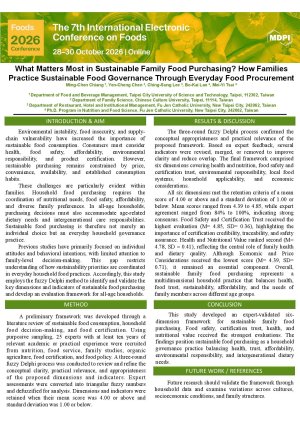
Contemporary families face multiple considerations when practicing sustainable food consumption, including health needs, food safety, affordability, environmental responsibility, and intergenerational dietary care. Family food purchasing is therefore not merely an individual consumer choice, but a decision making practice involving everyday coordination and household governance. This study aims to develop an evaluation framework for sustainable family food purchasing applicable to households with members across age groups. The fuzzy Delphi method was employed to build expert consensus and confirm the conceptual appropriateness, practical relevance, and clarity of the proposed dimensions and indicators. Based on a literature review, an initial framework was developed, and experts participated in three rounds of evaluation. Fuzzy linguistic assessment, triangular fuzzy numbers, and defuzzification procedures were used to examine the indicators, while mean scores and standard deviations served as retention criteria for the dimensions and indicators. The results show a high level of consistency among experts. All six dimensions met the retention criteria of a mean score of 4.00 or above and a standard deviation of 1.00 or below. Mean scores ranged from 4.39 to 4.85. Food Safety and Certification Trust received the highest evaluation (MS = 4.85, SD = 0.36), followed by Health and Nutritional Value (MS = 4.78, SD = 0.41). Economic and Price Considerations received the lowest score (MS = 4.39, SD = 0.71), but still met the retention criteria, indicating that affordability remains a necessary condition for sustainable household food purchasing. This study repositions sustainable food purchasing as a micro level governance practice within family contexts and provides a framework for family food education, sustainable consumption promotion, and food policy design.
Keywords
Sustainable food purchasing
Family food consumption
All-age households
Fuzzy Delphi method
Food safety and certification trust
Household governance
Poster
Foods poster-What Matters Most in Sustainable Family Food Purchasing How Families Practice Sustainable Food Governance Through Everyday Food Procurement.pdf
From Bovine Bone Waste to Value-Added Resources: Opportunities for Circular Bioeconomy in the Meat Industry
Fermentation-Driven Inactivation of Salmonella Enteritidis: Linking Microbiome Succession and Physicochemical Dynamics