Event submissions
Published
This submission belongs to the session G. Food Safety, Toxicology & Quality of the event The 7th International Electronic Conference on Foods
Published date
23 Oct, 2026
Academic Editor
 Esther Sendra
Citation
Philip Junior Yeboah, Tingting Gu, Andrew MacIntosh, Katherine Thompson-Witrick, Boce Zhang, Fermentation-Driven Inactivation of Salmonella Enteritidis: Linking Microbiome Succession and Physicochemical Dynamics, in Proceedings of The 7th International Electronic Conference on Foods, 28 October–30 October 2026, MDPI: Basel, Switzerland
Share
Email
Facebook
Twitter
LinkedIn
Fermentation-Driven Inactivation of Salmonella Enteritidis: Linking Microbiome Succession and Physicochemical Dynamics

Philip Junior Yeboah 1
Tingting Gu 1
Andrew MacIntosh 1
Katherine Thompson-Witrick 1

Boce Zhang 1
1. Department of Food Science and Human Nutrition, University of Florida, Gainesville, 32611, United States
Abstract
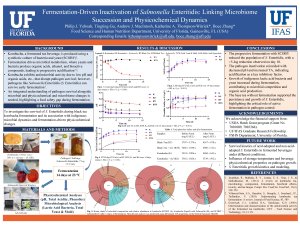
Acidic fermented beverages contain active microbial communities that produce organic acids and other antimicrobial metabolites that can limit the survival of foodborne pathogens. This study investigated the survival of Salmonella Enteritidis in acidic fermented beverage (kombucha) and the associated physicochemical, microbiological, and microbiome analyses over a 14-day fermentation.
Kombucha was prepared using 1.6% (w/v) black tea, 10% (w/v) sucrose, and a starter culture containing a symbiotic culture of bacteria and yeast (SCOBY). The SCOBY consisted of cellulose-based pellicle together with previously fermented kombucha broth. The beverage was inoculated with 7.2 log CFU/mL of Salmonella and fermented at 23 ± 1.0 ℃ for 14 days. Pathogen populations, lactic acid bacteria (LAB), total yeast and mold (TYM), microbiome composition, pH, titratable acidity, and total phenolic content (TPC) were monitored over 14 days. Microbiome profiling of kombucha with Salmonella and SCOBY with Salmonella was evaluated after fermentation. Significant differences (p ≤ 0.05) were determined using one-way analysis of variance while microbiome data were analyzed using the Galaxy Nanopore bioinformatics platform.
The initial Salmonella population (7.24 ± 0.44 log CFU/mL) decreased by 5 log units by day 10 (2.01 ± 0.1 log CFU/mL) and further declined to 1.4 ± 0.3 log CFU/mL by day 14, while the Salmonella population in the non-fermentable control increased and remained stable throughout the fermentation. The Salmonella reduction coincided with decreases in pH and an increase in titratable acidity. LAB and TYM populations increased during fermentation, indicating active microbial metabolism. TPC increased, indicating a breakdown of complex compounds. Microbiome analysis of kombucha and SCOBY samples showed that both the fermented liquid and SCOBY maintained fermentation-associated communities, including yeasts/fungi, acetic acid bacteria, and LAB-related organisms, while Salmonella declined by the end of fermentation.
These findings demonstrate that acidic fermented beverages can suppress Salmonella Enteritidis through combined physicochemical and microbial changes. Using kombucha as a model matrix, this study provides insight into pathogen behavior and microbial safety in acidic fermented beverage systems.
Keywords
Salmonella Enteritidis
Acidic fermented beverages
Microbiome
Fermentation
Pathogen survival
Poster
MDPI Virtual Conference Poster.pdf
Negotiating Sustainability at the Family Table: Sustainable Food Purchasing in All-Age Households
Assessment of Household Food Waste and Consumer Behaviours in Portugal Using Smart Scale Technology