Event submissions
Published
This submission belongs to the session E. Sustainable Food System & Food Security of the event The 7th International Electronic Conference on Foods
Published date
23 Oct, 2026
Academic Editor
 Abdalbasit Adam Mariod
Citation
Kamila Soares, Carla Gonçalves, Joana Paiva, Dejan Gradišar, Miha Glavan, Alexandra Esteves, Cristina Saraiva, Assessment of Household Food Waste and Consumer Behaviours in Portugal Using Smart Scale Technology, in Proceedings of The 7th International Electronic Conference on Foods, 28 October–30 October 2026, MDPI: Basel, Switzerland
Share
Email
Facebook
Twitter
LinkedIn
Assessment of Household Food Waste and Consumer Behaviours in Portugal Using Smart Scale Technology

Kamila Soares 1,2,3

Carla Gonçalves 4,5,6

Joana Paiva 1,2,3

Dejan Gradišar 7
Miha Glavan 7
Alexandra Esteves 1,2,3

Cristina Saraiva 1,2,3
1. Veterinary and Animal Research Centre (CECAV), University of Trás-os-Montes e Alto Douro (UTAD), 5000-801 Vila Real, Portugal
2. Associate Laboratory for Animal and Veterinary Sciences (AL4AnimalS), Vila Real 5000-801, Portugal
3. School of Agrarian and Veterinary Sciences (ECAV), University of Trás-os-Montes e Alto Douro (UTAD), 5000-801 Vila Real, Portugal.
4. Centre for the Research and Technology of Agro-Environmental and Biological Sciences (CITAB), University of Trás-os-Montes e Alto Douro, 5000-801 Vila Real, Portugal
5. Epidemiology Research Unit, Laboratory for Integrative and Translational Research in Population Health, Institute of Public Health, University of Porto, 4050-600 Porto, Portugal
6. Health, School of Life and Environmental Sciences (RISE), University of Trás os-Montes and Alto Douro, 5000-801, Vila Real, Portugal
7. Department of system and Control, Jožef Stefan Institute (JSI), Jamova 39, Ljubljna, 1000, Slovenia
Abstract
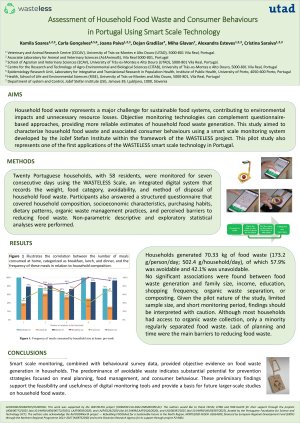
Aims: Household food waste represents a major challenge for sustainable food systems, contributing to environmental impacts and unnecessary resource losses. Objective monitoring technologies can complement questionnaire-based approaches, providing more reliable estimates of household food waste generation. This study aimed to characterize household food waste and associated consumer behaviours using a smart scale monitoring system developed by the Jožef Stefan Institute within the framework of the WASTELESS project. This pilot study also represents one of the first applications of the WASTELESS smart scale technology in Portugal.
Methods: Twenty Portuguese households, with 58 residents, were monitored for seven consecutive days using the WASTELESS Scale, an integrated digital system that records the weight, food category, avoidability, and method of disposal of household food waste. Participants also answered a structured questionnaire that covered household composition, socioeconomic characteristics, purchasing habits, dietary patterns, organic waste management practices, and perceived barriers to reducing food waste. Non-parametric descriptive and exploratory statistical analyses were performed.
Results and Discussion: During the monitoring period, households generated 70.33 kg of food waste, which corresponds to 173.2 g/person/day and 502.4 g/household/day. Avoidable food waste represented 57.9% of the total, corresponding to 40.72 kg and 100.3 g/person/day, while unavoidable food waste represented 42.1%, corresponding to 29.61 kg and 72.9 g/person/day. Family size, income, education level, shopping frequency, separation of organic waste, and composting did not show a significant association with total food waste generation. These findings should be interpreted considering the pilot nature of the study, the limited sample size, and the short monitoring period. Most families reported having access to organic waste collection, but only a minority regularly separated food waste. Absence of planning and lack of time were the main barriers reported for reducing food waste.
Conclusions: Smart scale monitoring, combined with behavioural survey data, provided objective evidence on food waste generation in households. The predominance of avoidable waste indicates substantial potential for prevention strategies focused on meal planning, food management, and consumer behaviour. These preliminary findings support the feasibility and usefulness of digital monitoring tools and provide a basis for future larger-scale studies on household food waste.
Keywords
Household food waste
Smart scale
Consumer behaviour
Waste prevention
Digital monitoring
Sustainable food systems
Poster
Poster 7 Foods.pdf
Fermentation-Driven Inactivation of Salmonella Enteritidis: Linking Microbiome Succession and Physicochemical Dynamics
Short-term effects of Opuntia dillenii fruit-derived products consumption on plasma antioxidant capacity in healthy adults: A pilot study