Event submissions
Published
This submission belongs to the session B. Nutritional & Functional Foods of the event The 7th International Electronic Conference on Foods
Published date
23 Oct, 2026
Academic Editor
 Manuel Viuda-Martos
Citation
Yurima Díaz-Rivero, Ruymán Santana-Farré, Nisa Buset-Ríos, Mussa Makran, Short-term effects of Opuntia dillenii fruit-derived products consumption on plasma antioxidant capacity in healthy adults: A pilot study, in Proceedings of The 7th International Electronic Conference on Foods, 28 October–30 October 2026, MDPI: Basel, Switzerland
Share
Email
Facebook
Twitter
LinkedIn
Short-term effects of Opuntia dillenii fruit-derived products consumption on plasma antioxidant capacity in healthy adults: A pilot study

Yurima Díaz-Rivero 1
Ruymán Santana-Farré 1,2

Nisa Buset-Ríos 2

Mussa Makran 1
1. Department of Nutrition, Faculty of Health Sciences, Universidad Fernando Pessoa-Canarias, 35450 Santa María de Guía, Las Palmas, Spain
2. Department of Basic Health Sciences, Faculty of Health Sciences, Universidad Fernando Pessoa-Canarias, 35450 Santa María de Guía, Las Palmas, Spain
Abstract
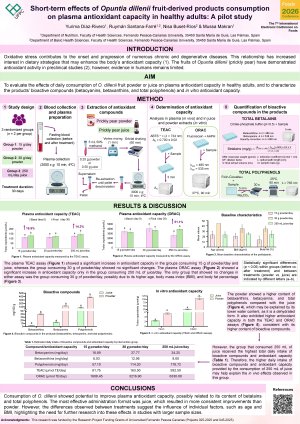
Introduction: Oxidative stress is involved in the pathogenesis of several chronic diseases and may be attenuated through the intake of dietary antioxidants. Fruits of Opuntia dillenii (prickly pear) have demonstrated antioxidant properties in preclinical studies; however, evidence in humans remains scarce. Methods: This pilot study aimed to assess the short-term effects of O. dillenii fruit-derived products on plasma antioxidant capacity in healthy adults. Six participants were randomly allocated into three groups (n = 2 per group) and consumed for 30 days either dehydrated fruit powder (15 or 30 g/day) or fruit juice (250 mL/day). Plasma antioxidant capacity was evaluated before and after the intervention using TEAC and ORAC assays. Additionally, total phenolic content, total betalain content, and antioxidant capacity (TEAC and ORAC) were determined in the tested products. Results and Discussion: Post-intervention, plasma TEAC values increased significantly in the groups consuming 15 g/day of fruit powder (+16.9%) and juice (+14.2%), whereas the 30 g/day fruit powder group showed a non-significant increase (+7.1%). Interestingly, only the juice group exhibited a significant increase in ORAC values (+51.1%). Based on the estimated daily intake, the juice provided a higher antioxidant load than the powder formulations, supplying higher amounts of phenolic compounds (178 vs. 57.1-114.2 mg/day), betalains (43.3 vs. 24.9-49.8 mg/day), and antioxidant capacity, as determined by TEAC (592 vs. 81.2-163.5 µmol Trolox equivalents/day) and ORAC assays (6330 vs. 1608.5-3212.9 µmol Trolox equivalents/day). This higher antioxidant load may partly explain the stronger response observed following juice consumption, whereas the lack of response in the 30 g/day powder group may could be attributable to individual participant characteristics. Conclusions: These preliminary findings suggest that short-term consumption of O. dillenii fruit-derived products may enhance plasma antioxidant capacity, with fruit juice showing the most pronounced effects. Further studies in larger populations are warranted to confirm these results.
Keywords
Opuntia
functional foods
antioxidants
bioactive compounds
nutraceuticals
Poster
Poster_Opuntia_Foods_21.09.2026_DEF.pdf
Assessment of Household Food Waste and Consumer Behaviours in Portugal Using Smart Scale Technology
Reformulation of "Toscana" Sausage: Reduction of Sodium and Curing Salts Using Potassium Chloride and Spray-Dried Rosemary Extract