Event submissions
Published
This submission belongs to the session E. Sustainable Food System & Food Security of the event The 7th International Electronic Conference on Foods
Published date
23 Oct, 2026
Academic Editor
 Abdalbasit Adam Mariod
Citation
Pedrão Reghiany Mayka, Fábio Augusto Garcia Coró, UELINTON MAXSUEL BATISTA, Alexandre Da Trindade Alfaro, Reformulation of "Toscana" Sausage: Reduction of Sodium and Curing Salts Using Potassium Chloride and Spray-Dried Rosemary Extract, in Proceedings of The 7th International Electronic Conference on Foods, 28 October–30 October 2026, MDPI: Basel, Switzerland
Share
Email
Facebook
Twitter
LinkedIn
Reformulation of "Toscana" Sausage: Reduction of Sodium and Curing Salts Using Potassium Chloride and Spray-Dried Rosemary Extract

Pedrão Reghiany Mayka 1
Fábio Augusto Garcia Coró 1
UELINTON MAXSUEL BATISTA 1

Alexandre Da Trindade Alfaro 1
1. Program in Food Technology (PPGTAL), Federal Technological University of Paraná (UTFPR), Londrina Campus, Londrina, PR, Brazil
Abstract
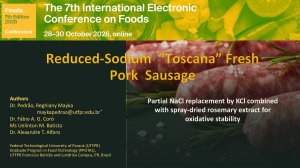
The search for healthier meat products has driven the demand for sausages with reduced sodium chloride (NaCl) and curing salts. This study evaluated the technological and oxidative parameters of a fresh pork sausage ("Toscana" type) formulated with partial substitution of NaCl by KCl (25% to 50%) and the incorporation of spray-dried rosemary (Rosmarinus officinalis) extract (0.05% to 0.4%) during 14 days of refrigerated storage (4C). Formulations were assessed for physicochemical standards, water-holding capacity (WHC), cooking loss (CL), emulsion stability, lipid oxidation (TBARS), and color parameters (L*, a* and b*). All formulations complied with Brazilian Standards of Identity and Quality (PIQ). A 30% NaCl substitution with KCl maintained WHC and CL (p > 0.05) comparable to the control, preserving batter texture without compromising emulsion stability (p < 0.05). During 14 days of storage, the incorporation of 0.2% and 0.4% rosemary extract significantly reduced lipid oxidation, lowering TBARS values by up to 45% compared to the reduced-nitrite control (p < 0.05). Furthermore, the extract effectively preserved redness (a*) over time (p < 0.05), delaying discoloration. In conclusion, a 30% NaCl reduction combined with 0.2% rosemary extract maintains the technological properties and extends the oxidative stability of "Toscana" pork sausage, serving as an effective strategy to reduce conventional additives.
Keywords
Rosmarinus officinalis
Potassium chloride
Sodium nitrite
Lipid oxidation
Meat product.
Poster
Toscana sausage.pdf
Short-term effects of Opuntia dillenii fruit-derived products consumption on plasma antioxidant capacity in healthy adults: A pilot study
The impact of seasonal weather on mycotoxin content in barley, triticale and oat during a two-year cropping period (2024-2025)