Event submissions
Published
This submission belongs to the session G. Food Safety, Toxicology & Quality of the event The 7th International Electronic Conference on Foods
Published date
23 Oct, 2026
Academic Editor
 Esther Sendra
Citation
Nina Kudumija, Sanja Furmeg, Tina Lešić, Ana Vulić, Jelka Pleadin, Manuela Zadravec, The impact of seasonal weather on mycotoxin content in barley, triticale and oat during a two-year cropping period (2024-2025), in Proceedings of The 7th International Electronic Conference on Foods, 28 October–30 October 2026, MDPI: Basel, Switzerland
Share
Email
Facebook
Twitter
LinkedIn
The impact of seasonal weather on mycotoxin content in barley, triticale and oat during a two-year cropping period (2024-2025)

Nina Kudumija 1

Sanja Furmeg 2
Tina Lešić 1

Ana Vulić 1

Jelka Pleadin 1

Manuela Zadravec 3
1. Croatian veterinary institute, Laboratory for analytical chemistry, Savska cesta 143, 10000 Zagreb, Croatia
2. Croatian veterinary institute, Veterinary institute Križevci, Ivana Zakmardija Dijankovečkog 10, 48260 Križevci, Croatia
3. Croatian veterinary institute, Laboratory for feed microbiology, Savska cesta 143, 10000 Zagreb, Croatia
Abstract
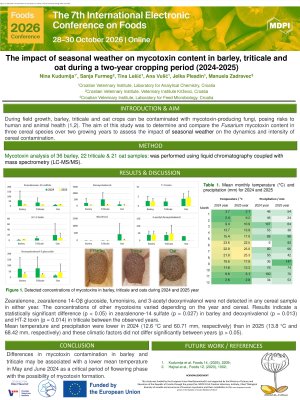
During field growth, barley, triticale and oat crops can be contaminated with mycotoxin-producing fungi, posing risks to human and animal health. The aim of this study was to determine and compare the Fusarium mycotoxin content in three cereal species over two growing years to assess the impact of seasonal weather on the dynamics and intensity of cereal contamination. For this purpose, 36 barley, 22 triticale and 21 oat samples were analyzed. In both years, cereal samples were collected from the same fields in northern and eastern Croatia. Mycotoxin analysis (zearalenone, zearalenone 14-Oβ glucoside, zearalenone-14 sulfate, deoxynivalenol, T-2 and HT-2 toxin, fumonisin B1 and B2, nivalenol, 3-acetyl deoxynivalenol and deoxynivalenol 3 glucoside) was performed using liquid chromatography coupled with mass spectrometry (LC-MS/MS). Zearalenone, zearalenone 14-Oβ glucoside, fumonisins, and 3-acetyl deoxynivalenol were not detected in any cereal sample in either year. Nivalenol was not detected in barley and triticale in 2024, while T-2 and HT-2 toxins were not detected in triticale in 2025. The concentrations of other mycotoxins varied depending on the year and cereal, with deoxynivalenol showing the highest incidence, at concentrations from 22.74 to 1638.88 μg/kg. Furthermore, the results indicate a statistically significant difference (p < 0.05) in zearalenone-14 sulfate (p = 0.027) in barley and deoxynivalenol (p = 0.013) and HT-2 toxin (p = 0.014) in triticale between the observed years. Although, mean temperature and precipitation were lower in 2024 (12.6 °C and 60.71 mm, respectively) than in 2025 (13.8 °C and 68.42 mm, respectively) and these climatic factors did not differ significantly between years (p > 0.05). However, differences in mycotoxin contamination in barley and triticale may be associated with a lower mean temperature in May and June 2024 as a critical period of flowering phase with the possibility of mycotoxin formation.
Keywords
Fusarium
cereals
mycotoxins
LC-MS/MS
contamination
Poster
Kudumija et al_Foods 2026 _poster.pdf
Reformulation of "Toscana" Sausage: Reduction of Sodium and Curing Salts Using Potassium Chloride and Spray-Dried Rosemary Extract
Partial Substitution of pork Fat by a Gelled Emulsion Formulated with Pomegranate Peel Flour and Quinoa Oil: Impact on Chemical Composition, Physicochemical Attributes, and Sensory Quality of Beef Burgers