Event submissions
Published
This submission belongs to the session B. Nutritional & Functional Foods of the event The 7th International Electronic Conference on Foods
Published date
23 Oct, 2026
Academic Editor
 Arun K. Bhunia
Citation
Raquel Lucas-Gonzalez, José A. Pérez-Alvarez, Jose Manuel Lorenzo, Manuel Viuda-Martos, Juana Fernández-López, Partial Substitution of pork Fat by a Gelled Emulsion Formulated with Pomegranate Peel Flour and Quinoa Oil: Impact on Chemical Composition, Physicochemical Attributes, and Sensory Quality of Beef Burgers, in Proceedings of The 7th International Electronic Conference on Foods, 28 October–30 October 2026, MDPI: Basel, Switzerland
Share
Email
Facebook
Twitter
LinkedIn
Partial Substitution of pork Fat by a Gelled Emulsion Formulated with Pomegranate Peel Flour and Quinoa Oil: Impact on Chemical Composition, Physicochemical Attributes, and Sensory Quality of Beef Burgers

Raquel Lucas-Gonzalez 1

José A. Pérez-Alvarez 1

Jose Manuel Lorenzo 2,3

Manuel Viuda-Martos 4

Juana Fernández-López 1
1. IPOA Research Group, Institute for Agri-Food and Agri-Environmental Research and Innovation (CIAGRO-UMH), Miguel Hernández University, 03312, Orihuela, Alicante, Spain.
2. Centro Tecnológico de la Carne de Galicia, 32900 Ourense, Spain
3. Universidade de Vigo, Área de Tecnología de los Alimentos, Facultad de Ciencias de Ourense, 32004 Ourense, Spain
4. Institute for Agri-Food and Agri-Environmental Research and Innovation (CIAGRO-UMH), Miguel Hernández University, 03312, Orihuela, Alicante, Spain.
Abstract
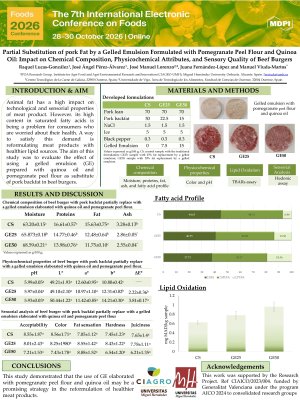
Animal fat has a high impact on technological and sensorial properties of meat product. However, its high content in saturated fatty acids is being a problem for consumers who are worried about their health. A way to satisfy this demand is reformulating meat products with healthier lipid sources. A gelled emulsion (GE) prepared with quinoa oil and pomegranate peel flour was used to replace pork back fat in beef burgers. Three different formulations were prepared: Control (CS) with 30% pork back fat, and the following two to achieve 25% and 50% fat substitution by GE (GE25 and GE50, respectively). The chemical composition, physicochemical, and sensorial properties of the beef burgers were determined. The replacement of animal fat by GE25 and GE50 produced an increases in the moisture content (p<0.05) with respect to CS. On the other hand, the fat, protein and ash content of GE25 and GE50 was lower (p<0.05) than CS. Additionally, in GE25 and GE50 the amount of palmitic, stearic, and oleic fatty acids was decreased while increased the amount of linoleic (from 5.68 to 16.94 g/100g fat) and α-linolenic (from 0.30 to 1.68 g/100g fat). Replacing pork backfat with GE did not significantly (p<0.05) affect the physicochemical properties of beef burgers, except for texture profile, where hardness and chewiness were reduces compared with CS. In reference to lipid oxidation values, the higher the degree of fat replacement, the higher the lipid oxidation values. Thus, lipid oxidation increased 26% and 40% for GE25 and GE50 with respect to CS. In sensorial analysis, burger GE25 had similar scores that CS being GE50 the worst valued. So, this study demonstrated that the use of GE elaborated with pomegranate peel flour and quinoa oil may be a promising strategy in the reformulation of healthier meat products.
Keywords
Reformulation
vegetable oils
oil structuring
polyunsaturated fatty acid
Functional food
Poster
Poster Fat replacement.pdf
The impact of seasonal weather on mycotoxin content in barley, triticale and oat during a two-year cropping period (2024-2025)
Highlighting the Underestimated Role of Fungi in Food Safety and Occupational Health: Preliminary Screening of Potential Mycotoxigenic Fungi Isolated from Slaughterhouses and Cutting Rooms in Northern Portugal