Event submissions
Published
This submission belongs to the session G. Food Safety, Toxicology & Quality of the event The 7th International Electronic Conference on Foods
Published date
23 Oct, 2026
Academic Editor
 Esther Sendra
Citation
Melissa Alves Rodrigues, Laís Freitas, Arianna Marante, Kamila Soares, Claudemar Oliveira, Letícia Estevinho, Rosa Capita, Alexandra Esteves, Highlighting the Underestimated Role of Fungi in Food Safety and Occupational Health: Preliminary Screening of Potential Mycotoxigenic Fungi Isolated from Slaughterhouses and Cutting Rooms in Northern Portugal, in Proceedings of The 7th International Electronic Conference on Foods, 28 October–30 October 2026, MDPI: Basel, Switzerland
Share
Email
Facebook
Twitter
LinkedIn
Highlighting the Underestimated Role of Fungi in Food Safety and Occupational Health: Preliminary Screening of Potential Mycotoxigenic Fungi Isolated from Slaughterhouses and Cutting Rooms in Northern Portugal

Melissa Alves Rodrigues 1

Laís Freitas 1,2
Arianna Marante 3
Kamila Soares 3
Claudemar Oliveira 4

Letícia Estevinho 2,4
Rosa Capita 5,6
Alexandra Esteves 3,7
1. Doctoral School, University of León (ULE), Campus de Vegazana, 24007 León, Spain
2. Centro de Investigação de Montanha (CIMO), Instituto Politécnico de Bragança, Campus de Santa Apolónia, 5300-252 Bragança, Portugal
3. Veterinary and Animal Research Center (CECAV), University of Trás-os-Montes e Alto Douro (UTAD), 5000-801 Vila Real, Portugal
4. Laboratório para a Sustentabilidade e Tecnologia em Regiões de Montanha, Instituto Politécnico de Bragança, Campus de Santa Apolónia, Bragança, Portugal
5. Department of Food Hygiene and Technology, Veterinary Faculty, University of León, E-24071, León, Spain
6. Institute of Food Science and Technology, University of León, E-24071, León, Spain
7. Department of Veterinary Science, School of Agrarian and Veterinary Science (ECAV), University of Trás-os-Montes e Alto Douro (UTAD), 5000-801 Vila Real, Portugal
Abstract
Background: Mycotoxins are fungal secondary metabolites with carcinogenic and genotoxic potential, and contamination can occur throughout meat processing facilities. Assessing the presence of mycotoxin-producing fungi is essential for food safety and occupational health within a One Health framework. Coconut Agar Medium (CAM) allows screening of fungal isolates for mycotoxin production, specifically aflatoxin and citrinin, detectable as fluorescence under UV light. This study performed a preliminary screening of fungi isolated from slaughterhouses and cutting rooms in northern Portugal.
Methods: Between July and December 2025, air, surface, and carcass samples were collected from slaughterhouses and cutting rooms for ruminants and pigs in northern Portugal. Air samples were collected passively using Chloramphenicol Glucose Agar (CGA) Petri dishes, while carcass and surface samples were obtained with sterile pre-moistened sponges. Fungal isolates were screened for mycotoxigenic potential on Coconut Agar Medium (CAM) using UV fluorescence (365 nm). Pure cultures were subcultured in the last week of February, excluding yeast-containing plates, and some sampling locations yielded more than one plate if multiple fungal species were isolated.
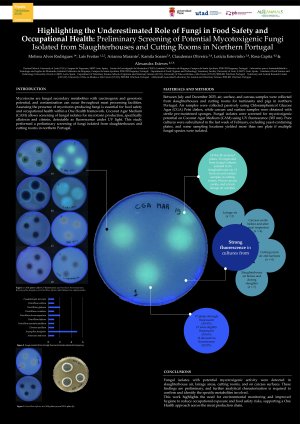
Results: Of the 48 analysed plates, 20 originated from fungal cultures isolated from slaughterhouse air, 13 from air and surface samples in cutting rooms, 9 from carcass swabs, and 6 from lairage air samples. Seventeen plates were strongly fluorescent (35.4%), 19 were slightly fluorescent (39.6%), and 12 showed no fluorescence (25.0%). Strong fluorescence was observed in cultures from slaughterhouse air before and during slaughter (n = 7), lairage air (n = 2), cutting room air and surfaces (n = 4), and carcass swabs before and after meat inspection (n = 4). Sequencing of isolates from fluorescent and slightly fluorescent plates revealed a diverse range of fungal species, including A. fumigatus, P. brevicompactum, P. crustosum, P. canescens, and P. solitum.
Conclusions: Fungal isolates with potential mycotoxigenic activity were detected in slaughterhouse air, lairage areas, cutting rooms, and on carcass surfaces. Fungal isolates with potential mycotoxigenic activity were detected in slaughterhouse air, lairage areas, cutting rooms, and on carcass surfaces. These findings are preliminary, and further analytical characterisation is required to confirm and identify the specific metabolites involved.
Keywords
Coconut agar medium
fungi
meat
mycotoxigenic potential
Poster
Preliminary Screening of Potential Mycotoxigenic Fungi Isolated from Slaughterhouses and Cutting Rooms in Northern Portugal.pdf
Partial Substitution of pork Fat by a Gelled Emulsion Formulated with Pomegranate Peel Flour and Quinoa Oil: Impact on Chemical Composition, Physicochemical Attributes, and Sensory Quality of Beef Burgers
Smart, Ready-to-Use Nutritive Formulations of Portulaca oleracea L.-Loaded Food-Grade NADESs for Functional Food Development