Event submissions
Published
This submission belongs to the session B. Nutritional & Functional Foods of the event The 7th International Electronic Conference on Foods
Published date
23 Oct, 2026
Academic Editor
 Manuel Viuda-Martos
Citation
Tarik Sebbah, Edite Cunha, Djahira Hamed, Karima Bentaiba, M. Conceição Montenegro, Smart, Ready-to-Use Nutritive Formulations of Portulaca oleracea L.-Loaded Food-Grade NADESs for Functional Food Development, in Proceedings of The 7th International Electronic Conference on Foods, 28 October–30 October 2026, MDPI: Basel, Switzerland
Share
Email
Facebook
Twitter
LinkedIn
Smart, Ready-to-Use Nutritive Formulations of Portulaca oleracea L.-Loaded Food-Grade NADESs for Functional Food Development

Tarik Sebbah 1,2,3
Edite Cunha 2
Djahira Hamed 4
Karima Bentaiba 1

M. Conceição Montenegro 2
1. Pathological Experimental Research Laboratory (PERL), Faculty of Medicine, Hassiba Benbouali University of Chlef, Hay Essalem 02000, Chlef, Algeria
2. LAQV/REQUIMTE, Department of Chemical Sciences, Faculty of Pharmacy, University of Porto, R. Jorge de Viterbo Ferreira 228, 4050-313 Porto, Portugal
3. Laboratoire de Nutrition Clinique et Métabolique, Université Oran 1 Ahmed Benbella, BP 1524 El M’Naouer 31000 Oran. Algérie.
4. Laboratory of Applied Hydrology and Environment, Agri-Food Department, Faculty of Science and Technology, University of Ain Temouchent - Belhadj Bouchaib, PO BOX 284. 46000, Ain Temouchent, Algeria.
Abstract
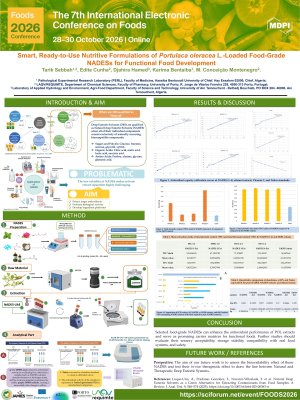
Background: Natural deep eutectic systems (NADESs) are increasingly explored as sustainable extraction media for bioactive compounds. Beyond extraction, food-grade NADESs may function as biocompatible carrier matrices for labile phytochemicals, eliminating energy-intensive solvent removal and supporting their direct use in functional food formulations as stabilizing, "ready-to-use" delivery platforms.
Objective: This study evaluated the yield of total phenolics and flavonoids, alongside the antioxidant activity, of selected food-grade NADESs loaded with Portulaca oleracea L. leaf extracts (POL), emphasizing their dual role as extraction media and bioactive ingredient platforms.
Methods: Four NADESs formulations were prepared to obtain POL extracts, which were assessed for total phenolic and flavonoid yields. The antioxidant activity of pure NADESs and corresponding POL-loaded extracts was evaluated using DPPH radical scavenging kinetics (expressed as IC50) and Trolox Equivalent Antioxidant Capacity (TEAC) assays. A conventional ethanol extract served as the control, and ascorbic acid as the reference antioxidant.
Results: NADESs extracts were highly rich with TPC and TFC, consequently the POL-loaded NADESs showed markedly higher antioxidant activity than the pure NADES vehicles and the ethanol extract, which presented an IC50 of 1615.96 ± 5.34 µg/mL and a TEAC value of 0.53. Among the tested systems, the menthol/lactic acid extract showed the strongest radical-scavenging activity, with an IC50 of 18.33 ± 0.72 µg/mL and a TEAC value of 5.37, remarkably outperforming the ascorbic acid reference under the same assay conditions. The menthol/β-citronellol extract also showed high antioxidant activity (IC50 = 51.51 ± 1.21 µg/mL; TEAC = 4.26). The β-citronellol/capric acid and menthol/acetic acid systems maintained relevant antioxidant capacity, with TEAC values of 4.12 and 4.14, respectively.
Conclusions: Selected food-grade NADESs can enhance the antioxidant performance of POL extracts and serve as promising carrier matrices for functional foods. Further studies should evaluate their sensory acceptability, storage stability, compatibility with real food systems, and safety.
Keywords
Purslane leaves
functional food ingredients
antioxidant synergy
bioactive carrier matrices
ready-to-use extracts
food-grade NADESs
Poster
FOODS 2026-Smart, Ready-to-Use Nutritive Formulations of Portulaca oleracea L.-Loaded Food-Grade NADESs for Functional Food Development.pdf
Highlighting the Underestimated Role of Fungi in Food Safety and Occupational Health: Preliminary Screening of Potential Mycotoxigenic Fungi Isolated from Slaughterhouses and Cutting Rooms in Northern Portugal
Natural Alternatives to Synthetic Additives in Meat Products: A Five-Year Review of Antioxidants, Antimicrobials, and Yeast-Derived Biomolecules