Event submissions
Published
This submission belongs to the session G. Food Safety, Toxicology & Quality of the event The 7th International Electronic Conference on Foods
Published date
23 Oct, 2026
Academic Editor
 Esther Sendra
Citation
Danica Mostoles, Javier Saurina, Sonia Sentellas, Oscar Núñez, LC-HRMS fingerprinting for Ecologic and Conventional Honey Discrimination, in Proceedings of The 7th International Electronic Conference on Foods, 28 October–30 October 2026, MDPI: Basel, Switzerland
Share
Email
Facebook
Twitter
LinkedIn
LC-HRMS fingerprinting for Ecologic and Conventional Honey Discrimination

Danica Mostoles 1,2

Javier Saurina 1,2

Sonia Sentellas 1,2,3

Oscar Núñez 1,2,3
1. Department of Chemical Engineering and Analytical Chemistry, University of Barcelona, Barcelona, Spain
2. Research Institute in Food Nutrition and Food Safety, University of Barcelona, Santa Coloma de Gramenet, Barcelona, Spain
3. Serra Húnter Lecturer, Generalitat de Catalunya, 08007 Barcelona, Spain
Abstract
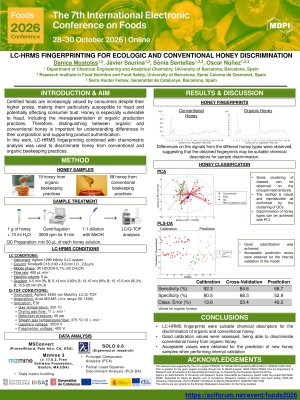
In recent years, food certifications associated with specific production practices have acquired considerable market significance and are widely recognized by consumers despite their generally higher prices. However, due to market differences and high value, these types of products are susceptible to fraud, consequently affecting consumer trust. Honey, in particular, is highly susceptible to fraud, including that associated with production certifications such as ecologic labeling. For this reason, it is important to study the differences on ecologic and conventional honey for a better understanding of its composition.
In this study, the classification of honey samples produced under conventional and ecologic beekeeping was evaluated using LC-HRMS fingerprinting. Analyses were performed on an LC-QTOF system, acquiring mass spectra over an m/z range of 50–1500. Raw data were subsequently processed with MSConvert and mzmine software to generate LC-HRMS fingerprints. Exploratory assessment of the fingerprinting data was conducted using principal component analysis (PCA), while class discrimination was performed through partial least squares-discriminant analysis (PLS-DA).
The results obtained from PCA demonstrated the effectiveness of LC-HRMS fingerprints as chemical descriptors for the differentiation of honey samples produced under ecologic and conventional beekeeping practices. PLS-DA achieved a cross-validated classification error of 16.5%, supporting the suitability of the proposed approach. Furthermore, variable importance projection (VIP) scores highlighted the variables most relevant to class discrimination, offering a starting point for the identification of chemical markers associated with specific production systems.
Overall, these findings highlight the potential of LC-HRMS fingerprinting as an approach to discriminate between ecologic and conventional honey, and provide valuable information into the compositional differences associated with these production systems.
Keywords
honey
ecologic beekeeping
authentication
lc-hrms fingerprinting
chemometrics
Poster
poster_foods_dm.pdf
Natural Alternatives to Synthetic Additives in Meat Products: A Five-Year Review of Antioxidants, Antimicrobials, and Yeast-Derived Biomolecules
Physico-chemical properties of a novel plant based milk alternative using coconut protein concentrate (CoPROTINA) and coconut dietary fiber (CoFBR): screening of formulation parameters