Event submissions
Published
This submission belongs to the session B. Nutritional & Functional Foods of the event The 7th International Electronic Conference on Foods
Published date
23 Oct, 2026
Academic Editor
 Manuel Viuda-Martos
Citation
Jin Mark De Guia Pagulayan, Mary Michelle Malabanan Velasquez, Casiana Blanca Jucar Villarino, Physico-chemical properties of a novel plant based milk alternative using coconut protein concentrate (CoPROTINA) and coconut dietary fiber (CoFBR): screening of formulation parameters, in Proceedings of The 7th International Electronic Conference on Foods, 28 October–30 October 2026, MDPI: Basel, Switzerland
Share
Email
Facebook
Twitter
LinkedIn
Physico-chemical properties of a novel plant based milk alternative using coconut protein concentrate (CoPROTINA) and coconut dietary fiber (CoFBR): screening of formulation parameters

Jin Mark De Guia Pagulayan 1

Mary Michelle Malabanan Velasquez 1

Casiana Blanca Jucar Villarino 1
1. Food Application and Sensory Laboratory, Department of Food Science and Nutrition, College of Home Economics, University of the Philippines Diliman, Quezon City 1101, Philippines
Abstract
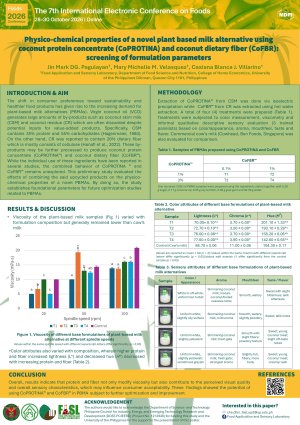
The shift in consumer preferences toward sustainability and healthier food products has given rise to the increasing demand for plant-based milk alternatives. Coconut protein concentrate (CoPROTINA™) and coconut dietary fiber (CoFBR™) are extracted from virgin coconut oil processing wastes, coconut skim milk and coconut residue, respectively. This preliminary study evaluated the effects of combining the said upcycled products on the physico-chemical properties of a novel plant-based milk alternative (PBMA). CoPROTINA™ were tested at 1% to 3% levels while CoFBR™were evaluated using 0.1 to 1% levels. Treatments were subjected to color measurement, viscometry and informal qualitative descriptive sensory evaluation (3 trained panelists) based on color/appearance, aroma, mouthfeel, taste and flavor. Viscosity of samples varied with formulation composition (5.00 - 19.30 mPa·s) but were generally lower compared to commercial cow milk (10.00 - 20.8- mPa·s) at different spindle speeds (20-100 rpm). Color attributes also varied with composition, wherein higher protein and fiber increased lightness (L*), and shift to a more neutral or yellowish hue value (H°). The sensory attributes of the four plant-based milk samples varied according to protein and fiber content with higher protein and fiber levels increasing body and slight fibrousness in the PBMA, while also intensifying aroma. Tastes are generally sweet, with minor off-notes in some high-fiber samples. Overall, the study showed the potential of using CoPROTINA and CoFBR in PBMA production and can be further optimized.
Keywords
Coconut protein concentrate
Coconut dietary fiber
Coconut skim milk
Coconut Residue
Plant-based Milk Alternative
Poster
22Sept2026 _ Foods 2027 Pagulayan et al.pdf
LC-HRMS fingerprinting for Ecologic and Conventional Honey Discrimination
Upcycling Virgin Coconut Oil Byproducts into Hybrid Textured Vegetable Protein for Plant-Based Sausages