Event submissions
Published
This submission belongs to the session E. Sustainable Food System & Food Security of the event The 7th International Electronic Conference on Foods
Published date
23 Oct, 2026
Academic Editor
 Abdalbasit Adam Mariod
Citation
Edward Peter De Guzman, Casiana Blanca Villarino, Jin Mark Pagulayan, Katharina Nilda Ann Viquezo, Upcycling Virgin Coconut Oil Byproducts into Hybrid Textured Vegetable Protein for Plant-Based Sausages, in Proceedings of The 7th International Electronic Conference on Foods, 28 October–30 October 2026, MDPI: Basel, Switzerland
Share
Email
Facebook
Twitter
LinkedIn
Upcycling Virgin Coconut Oil Byproducts into Hybrid Textured Vegetable Protein for Plant-Based Sausages

Edward Peter De Guzman 1

Casiana Blanca Villarino 1

Jin Mark Pagulayan 1
Katharina Nilda Ann Viquezo 1
1. Food Application and Sensory Laboratory, Department of Food Science and Nutrition, College of Home Economics, University of the Philippines Diliman, Quezon City 1101, Philippines.
Abstract
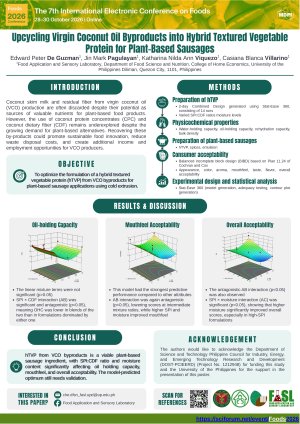
The rising demand for sustainable alternative proteins has driven the exploration of agro-industrial byproducts as functional food ingredients. Virgin coconut oil (VCO) wet processing generates protein- and fiber-rich residues that remain largely underutilized. This study optimized the formulation for producing hybrid textured vegetable protein (hTVP) from VCO byproducts for plant-based sausage applications using cold extrusion. Using Design-Expert®, a combined experimental design evaluated the effects of the soy protein isolate to coconut dietary fiber ratio (SPI:CDF, 70:30–90:10) and moisture content (60–70%) across 14 experimental runs. The functional properties of the resulting hTVP (i.e., bulk density, oil/water holding capacities, and rehydration capacity) and the sensory acceptability (9-point Hedonic rating) of the formulated plant-based sausages were modeled using multiple linear regression and response surface methodology. Significant models (p < 0.05) were established for hTVP oil holding capacity (2.47–3.08 g oil/g sample), and mouthfeel acceptability (5.43–6.93) and overall acceptability (6.14–7.21) of the plant-based sausages, indicating that the SPI:CDF ratio and moisture content strongly influence both ingredient functionality and product quality. However, experimental validation is still required to confirm the optimal conditions. This study demonstrates a viable method to upcycle VCO processing waste into functional ingredients, offering a more sustainable, resource-efficient raw material option for the rapidly growing plant-based meat industry.
Keywords
alternative proteins
cold extrusion
byproduct valorization
virgin coconut oil byproducts
response surface methodology
textured vegetable protein
Poster
Upcycling Virgin Coconut Oil Byproducts into Hybrid Textured Vegetable Protein for Plant-Based Sausages.pdf
Physico-chemical properties of a novel plant based milk alternative using coconut protein concentrate (CoPROTINA) and coconut dietary fiber (CoFBR): screening of formulation parameters
Valorizing Red Grape Pomace through the Development of Biscuits with Potential Health-Promoting Properties