Event submissions
Published
This submission belongs to the session B. Nutritional & Functional Foods of the event The 7th International Electronic Conference on Foods
Published date
23 Oct, 2026
Academic Editor
 Manuel Viuda-Martos
Citation
Luis Alberto Condezo Hoyos, Lilian Toribio-López, Paola Cortes-Avendaño, Multiphenolic inulin obtained by grafting with phenolic compound from Sambucus peruviana using a novel and hybrid dual intermediate frequency ultrasound procedure, in Proceedings of The 7th International Electronic Conference on Foods, 28 October–30 October 2026, MDPI: Basel, Switzerland
Share
Email
Facebook
Twitter
LinkedIn
Multiphenolic inulin obtained by grafting with phenolic compound from Sambucus peruviana using a novel and hybrid dual intermediate frequency ultrasound procedure

Luis Alberto Condezo Hoyos 1
Lilian Toribio-López 1
Paola Cortes-Avendaño 1
1. Innovative Technology, Food and Health Research Group, Facultad de Industrias Alimentarias, Universidad Nacional Agraria La Molina, Av. La Molina s/n, Lima, Perú
Abstract
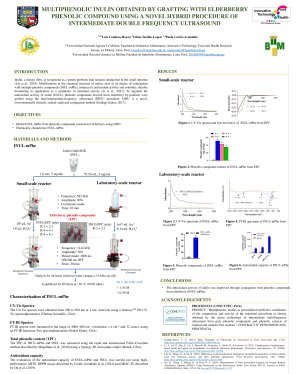
This study developed a novel hybrid dual intermediate-frequency ultrasound (hD-IFUS) process for the simultaneous grafting of phenolic compound (PC-SP) extracted from Sambucus peruviana onto inulin (INUL-mPhe) using an H2O2/ascorbic acid redox-pair system. The process, which combined sonication at 582 kHz (23.7 ± 0.9 W, continuous mode) and 1144 kHz (0.42 ± 0.04 W, pulsed mode; 1800 ms ON/200 ms OFF), was optimized in a small-scale reactor and subsequently scaled up to a laboratory-scale reactor. The highest grafting efficiency was achieved at INUL/PC-SP mass ratio of 2:1, as indicated by UV–Vis spectroscopy and total phenolic content (TPC) analysis (51.25 ± 3.05 mg GAE g–1). Second-derivative UV–Vis spectra confirmed the presence of PC-SP. Although chemical dosimetry was similar at both scales, the laboratory-scale process produced INUL-mPhe with a higher TPC (68.21 ± 2.10 mg GAE g–1), likely due to enhanced mixing. UV–Vis, FT–IR, and thermal analyses confirmed the successful incorporation of PC-SP into the inulin backbone. Furthermore, INUL-mPhe exhibited markedly enhanced antioxidant capacity measured by Single Electron Transfer (SET) and Hydrogen Atom Transfer (HAT) assay such as DPPH (418.62 ± 4.92 μmol Trolox g–1) and ABTS (322.78 ± 6.76 μmol Trolox g–1) and HAT assay as ORAC (1194.75 ± 18.02 μmol Trolox g–1). Overall, hD-IFUS represents a rapid, green, and effective strategy for producing multiphenolic inulin conjugates using PC-SP extracted by low frequency ultrasound.
Keywords
Polysaccharides
Phenolic compounds
Free radical grafting method
One-step and two-step methods
Antioxidant capacity.
Poster
FOODS-Poster-INUL-mPhe-LACH.pdf
Valorizing Red Grape Pomace through the Development of Biscuits with Potential Health-Promoting Properties
High-Throughput and Green Screening Methods for the Botanical Classification of Spanish Honeys Using UV–Vis and FIA-UV–Vis Spectral Fingerprints