Event submissions
Published
This submission belongs to the session G. Food Safety, Toxicology & Quality of the event The 7th International Electronic Conference on Foods
Published date
23 Oct, 2026
Academic Editor
 Esther Sendra
Citation
Gerard Luján, Danica Mostoles, Javier Saurina, Sònia Sentellas, Oscar Nuñez, High-Throughput and Green Screening Methods for the Botanical Classification of Spanish Honeys Using UV–Vis and FIA-UV–Vis Spectral Fingerprints, in Proceedings of The 7th International Electronic Conference on Foods, 28 October–30 October 2026, MDPI: Basel, Switzerland
Share
Email
Facebook
Twitter
LinkedIn
High-Throughput and Green Screening Methods for the Botanical Classification of Spanish Honeys Using UV–Vis and FIA-UV–Vis Spectral Fingerprints

Gerard Luján 1
Danica Mostoles 1,2

Javier Saurina 1,2

Sònia Sentellas 1,2,3

Oscar Nuñez 1,2,3
1. Department of Chemical Engineering and Analytical Chemistry, University of Barcelona, Barcelona, Spain
2. Research Institute in Food Nutrition and Food Safety, University of Barcelona, Santa Coloma de Gramenet, Barcelona, Spain
3. Serra Húnter Lecturer, Generalitat de Catalunya, 08007 Barcelona, Spain
Abstract
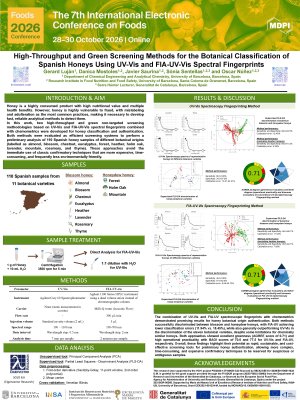
Honey is a highly consumed product with high nutritional value and multiple health benefits. However, honey is highly vulnerable to fraud, with mislabeling and adulteration as the most common practices, making it necessary to develop fast, reliable analytical methods to detect them.
In this work, two high-throughput and green non-targeted screening methodologies based on UV-Vis and FIA-UV-Vis spectral fingerprints combined with chemometrics were developed for honey classification and authentication. Both methods were evaluated as efficient screening systems to perform a preliminary analysis of 110 Spanish honey samples of different botanical origins (labelled as almond, blossom, chestnut, eucalyptus, forest, heather, holm oak, lavender, mountain, rosemary, and thyme). These approaches avoid the immediate use of classic confirmatory techniques that are more expensive, time-consuming, and frequently less environmentally friendly.
Principal component analysis yielded reasonably well-structured distributions according to botanical attributes; partial least squares-discriminant analysis provided acceptable sensitivity, specificity, and low classification error rates, confirming that non-targeted spectral fingerprints successfully capture key chemical markers, such as polyphenolic and floral absorption descriptors, required for robust differentiation.
Regarding method suitability, the automated FIA-UV-Vis method proved more efficient for classifying botanical varieties, demonstrating a high capacity to handle a large number of samples (ca. 30 samples per hour). Both methodologies confirmed that rapid analytical speed does not imply a sacrifice in classification accuracy. Their highly favorable environmental and operational performances were confirmed by sustainability and operational practicality metrics. Both systems achieved an identical AGREE score of 0.71 by avoiding the use of hazardous organic solvents, while the practical BAGI index yielded scores of 70.0 and 77.5 for UV-Vis and FIA-UV-Vis, respectively. This research provides the beekeeper sector with two eco-friendly and practical screening alternatives that successfully strengthen honey fraud prevention while ensuring low operational costs and a minimal ecological footprint.
Keywords
Honey Authentication
Botanical Classification
Fingerprinting
FIA-UV
UV-vis spectroscopy
Green methodologies
Poster
Poster Foods2026_Botanical Honey Screening.pdf
Multiphenolic inulin obtained by grafting with phenolic compound from Sambucus peruviana using a novel and hybrid dual intermediate frequency ultrasound procedure
Unlocking the Potential of Spent Coffee Grounds: From Agro-Industrial Waste to Functional Bioactive Ingredients