Event submissions
Published
This submission belongs to the session B. Nutritional & Functional Foods of the event The 7th International Electronic Conference on Foods
Published date
23 Oct, 2026
Academic Editor
 Manuel Viuda-Martos
Citation
Lucia Francesca Vuono, Vincenzo Sicari, Antonio Gattuso, Rosa Tundis, Monica Rosa Loizzo, Unlocking the Potential of Spent Coffee Grounds: From Agro-Industrial Waste to Functional Bioactive Ingredients, in Proceedings of The 7th International Electronic Conference on Foods, 28 October–30 October 2026, MDPI: Basel, Switzerland
Share
Email
Facebook
Twitter
LinkedIn
Unlocking the Potential of Spent Coffee Grounds: From Agro-Industrial Waste to Functional Bioactive Ingredients

Lucia Francesca Vuono 1
Vincenzo Sicari 2
Antonio Gattuso 2

Rosa Tundis 1

Monica Rosa Loizzo 1
1. Department of Pharmacy, Health and Nutritional Sciences, University of Calabria, Rende, 87036, Italy
2. Department of Agraria, University "Mediterranea" of Reggio Calabria, Reggio Calabria, 89124, Italy
Abstract
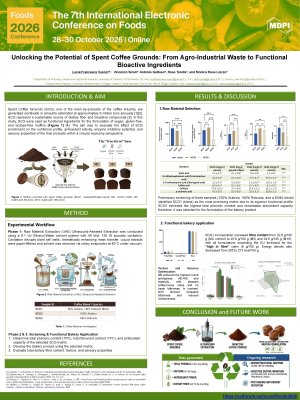
The increasing interest in sustainable food systems and circular economy approaches has heightened attention toward the valorisation of agro-industrial by-products as valuable sources of bioactive compounds. Among these, spent coffee grounds (SCG), the residue generated during coffee brewing, represent one of the most abundant food industry wastes worldwide. Despite being commonly discarded, SCG retain considerable amounts of valuable bioactive phytochemicals, making them a promising raw material for nutraceutical and food applications. To assess the influence of coffee matrix composition on SCG characteristics, three samples derived from a 60% Arabica/40% Robusta blend, 100% Arabica, and 100% Robusta coffee were investigated for their colorimetric properties, phenolic composition, and antioxidant activity. The observed differences among the samples underscore the substantial impact of coffee variety on the preservation of bioactive compounds in spent coffee grounds following extraction. The Arabica/Robusta blend was characterized by the highest total phenolic content (149.4 mg GAE/g extract) and radical scavenging potential, exhibiting IC₅₀ values of 44.5 and 27.5 μg/mL in the DPPH and ABTS assays, respectively. The UHPLC-DAD profiling enabled the identification of key phenolic compounds, including gallic, protocatechuic, chlorogenic, caffeic, and p-coumaric acids, along with caffeine, thereby confirming the potential of SCG as a valuable reservoir of bioactive molecules with recognized health-promoting properties. Although the 100% Robusta sample exhibited the highest concentrations of most phenolic acids, the Arabica/Robusta blend was characterized by the highest caffeine content and the strongest overall antioxidant activity. These findings highlight the potential of spent coffee grounds as a valuable source of phenolic compounds and antioxidants. Their rich bioactive profile supports their valorisation as sustainable functional ingredients for the development of value-added products, thereby promoting waste reduction and resource recovery within a circular economy framework.
Keywords
Spent coffee grounds (SCG)
Circular economy
Bioactive compounds
Phenolic compounds
Antioxidant activity
Coffee by-products
Functional ingredients.
Poster
Sciforum-195990 Lucia Francesca Vuono.pdf
High-Throughput and Green Screening Methods for the Botanical Classification of Spanish Honeys Using UV–Vis and FIA-UV–Vis Spectral Fingerprints
Transporter-Mediated Modulation of Veterinary Drug Residues in Milk: A One Health Computational Toxicology Framework