Event submissions
Published
This submission belongs to the session B. Nutritional & Functional Foods of the event The 7th International Electronic Conference on Foods
Published date
23 Oct, 2026
Academic Editor
 Manuel Viuda-Martos
Citation
Giuseppe Amato, Laura De Martino, Maria Neve Ombra, Vincenzo De Feo, Jesus Fernando Ayala Zavala, Filomena Nazzaro, Florinda Fratianni, Blackcurrant and Tomato Seed Oils: Distinct Fatty Acid Profiles with Shared Functional Potential, in Proceedings of The 7th International Electronic Conference on Foods, 28 October–30 October 2026, MDPI: Basel, Switzerland
Share
Email
Facebook
Twitter
LinkedIn
Blackcurrant and Tomato Seed Oils: Distinct Fatty Acid Profiles with Shared Functional Potential

Giuseppe Amato 1

Laura De Martino 1
Maria Neve Ombra 2

Vincenzo De Feo 1

Jesus Fernando Ayala Zavala 3

Filomena Nazzaro 2
Florinda Fratianni 2
1. DIFARMA-University of Salerno, Via Giovanni Paolo II, 132, 84084 Fisciano (SA), Italy
2. Institute of Food Sciences, CNR-ISA, Via Roma 64, 83100 Avellino, Italy
3. Research Center for Food and Development A. C., Gustavo Enrique Astiazaran Rosas No. 46, La Victoria, Building E, Hermosillo 83304, Sonora, Mexico
Abstract
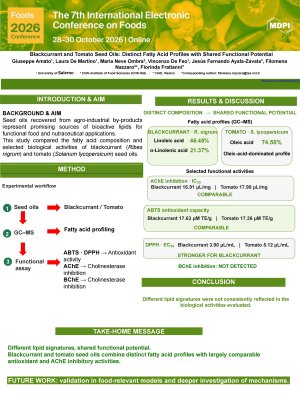
Seed oils recovered from agro-industrial by-products represent promising ingredients for the development of functional foods and nutraceuticals. This study comparatively investigated the fatty acid composition and selected biological activities of the lipid fractions obtained from Ribes nigrum and Solanum lycopersicum seeds. Fatty acid profiles were determined by GC–MS analysis. Antioxidant activity was evaluated by ABTS and DPPH assays; neuroprotective-related activities were assessed by inhibition of acetylcholinesterase (AChE), and butyrylcholinesterase (BChE). The two oils exhibited markedly different lipid signatures. Tomato seed oil was dominated by oleic acid (74.56%), whereas blackcurrant seed oil was characterized by high levels of linoleic (46.45%) and α-linolenic acids (21.37%). Despite these compositional differences, several biological activities were comparable between the two oils. Similar AChE inhibitory potency expressed as IC₅₀ was comparable (16.91 and 17.98 µL/mg), while no BChE inhibition was detected under the tested conditions. A comparable antioxidant capacity was also observed in the ABTS assay (17.63 and 17.36 µM TE/g). In contrast, blackcurrant seed oil showed stronger DPPH radical scavenging activity (EC₅₀ = 3.90 vs. 5.12 µL/mL DPPH). Conclusions: Although characterized by different fatty acid compositions, blackcurrant and tomato seed oils exhibited largely comparable functional properties. These findings indicate that differences in the predominance of MUFAs and PUFAs were not consistently associated with differences in the biological activities evaluated in this study, suggesting that minor constituents and interactions among lipid components may also contribute to the overall functional properties of seed oils.
Keywords
seed oils
fatty acids
agro-industrial by-products
neuroprotective activity
Poster
Tomato_Blackcurrant_poster_Foods2026_def.pdf
Transporter-Mediated Modulation of Veterinary Drug Residues in Milk: A One Health Computational Toxicology Framework
Effect of the incorporation of Neltuma affinis pod and soybean extruded-expeller meal flours on the technological properties of gluten-free fresh pasta