Event submissions
Published
This submission belongs to the session B. Nutritional & Functional Foods of the event The 7th International Electronic Conference on Foods
Published date
23 Oct, 2026
Academic Editor
 Manuel Viuda-Martos
Citation
Nancy Noemí Espósito, Angelina Campañá, Karen Florencia Irigoytia, Carolina Elizabeth Genevois, Effect of the incorporation of Neltuma affinis pod and soybean extruded-expeller meal flours on the technological properties of gluten-free fresh pasta, in Proceedings of The 7th International Electronic Conference on Foods, 28 October–30 October 2026, MDPI: Basel, Switzerland
Share
Email
Facebook
Twitter
LinkedIn
Effect of the incorporation of Neltuma affinis pod and soybean extruded-expeller meal flours on the technological properties of gluten-free fresh pasta

Nancy Noemí Espósito 1,2,3
Angelina Campañá 3
Karen Florencia Irigoytia 1,2,3,4
Carolina Elizabeth Genevois 1,2,3
1. Institute of Food Science and Technology of Entre Ríos (ICTAER), National Scientific and Technical Research Council (CONICET) – National University of Entre Ríos (UNER), Gualeguaychú, Entre Ríos E2820, Argentina.
2. National Scientific and Technical Research Council (CONICET), Buenos Aires C1425FQB, Argentina.
3. Faculty of Bromatology, National University of Entre Ríos (UNER), Gualeguaychú, Entre Ríos E2820, Argentina.
4. Department of Industries, Faculty of Exact and Natural Sciences, University of Buenos Aires, Buenos Aires C1428BGA, Argentina.
Abstract
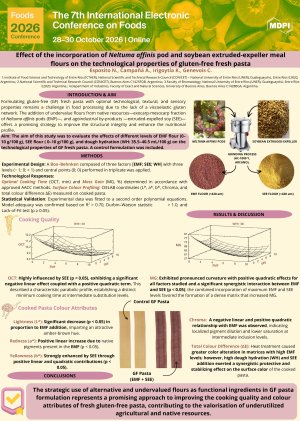
Developing gluten-free (GF) pasta with high nutritional and technological quality remains a critical challenge for the food industry, requiring the substitution of gluten with alternative matrices. This study evaluated the effect of incorporating exocarp-mesocarp flour obtained from the milling process of Neltuma affinis pod (EMF: 0–10 g/100g), soybean extruded–expelled meal (SEE: 0–10 g/100g), and dough hydration level (WH: 35.5–40.5 mL/100g) on the technological properties of GF fresh pasta. A Box-Behnken design with three central points by triplicate was implemented. Optimal cooking time (OCT) and mass gain (MG) were determined using standard AACC methods. Colour profiles (L*, a*, b*, Chroma, and ΔE; CIELAB) were evaluated in cooked pasta. Model adequacy was corroborated by coefficient of determination (R2) > 70%, Durbin-Watson statistics > 1, and lack-of-fit tests ≥ 0.05. All response variables were fitted to a second-order polynomial model. OCT was significantly affected (p<0.05) by a negative linear effect and a positive quadratic effect of SEE, describing a parabolic behaviour. MG exhibited a pronounced curvature with positive quadratic effects for all factors studied and a significant synergetic EMF-SEE interaction (p<0.05); where the combined incorporation of maximum levels of EMF and SEE promoted a dense matrix increasing MG. As regard chromatic profiles (p<0.05), EMF reduced L* and increased a*, whereas SEE enhanced b* via linear and positive quadratic effects. Chroma exhibited a negative linear and a positive quadratic EMF effect, denoting lower purity at intermediate levels and specific pigment dilution. ΔE analysis revealed that EMF increased thermal sensitivity, whilst both higher WH levels and SEE exerted a protective, stabilising effect on surface colour. The strategic combination of local regional flours and soy by-products, as functional ingredients, allows for the improvement of the technological properties of GF fresh pasta.
Keywords
Response surface methodology
Chromatic profiles
Mass gain
Sustainable food ingredients
Poster
ESPOSITO N. ET AL. CONFERENCE ON FOODS 2026.pdf
Blackcurrant and Tomato Seed Oils: Distinct Fatty Acid Profiles with Shared Functional Potential
Early phytotoxicity response of L. sativa L. to calcined bovine bone powder aqueous extracts through a germination bioassay