Event submissions
Published
This submission belongs to the session E. Sustainable Food System & Food Security of the event The 7th International Electronic Conference on Foods
Published date
23 Oct, 2026
Academic Editor
 Bimal Chitrakar
Citation
Claudia Montserrat Gómez-Leguizamón, Mercedes Jiménez-Rosado, Laura Regina León-Ovelar, Alberto Romero, Early phytotoxicity response of L. sativa L. to calcined bovine bone powder aqueous extracts through a germination bioassay, in Proceedings of The 7th International Electronic Conference on Foods, 28 October–30 October 2026, MDPI: Basel, Switzerland
Share
Email
Facebook
Twitter
LinkedIn
Early phytotoxicity response of L. sativa L. to calcined bovine bone powder aqueous extracts through a germination bioassay

Claudia Montserrat Gómez-Leguizamón 1,2
Mercedes Jiménez-Rosado 3
Laura Regina León-Ovelar 1

Alberto Romero 4
1. Faculty of Engineering, National University of Asunción, San Lorenzo, 2160, Paraguay
2. Department of Chemical Engineering, University of Seville, Seville, 41012, Spain
3. Chemical, Environmental and Bioprocess Engineering Group, I4 Institute, University of León, León, 24071, Spain
4. Department of Chemical Engineering, Faculty of Chemistry, University of Seville, Seville, 41012, Spain
Abstract
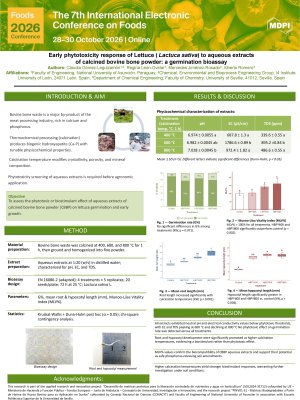
Thermochemical processing of bovine bone waste produces calcium phosphate-rich materials with potential for agricultural use. However, their effects on early plant development require assessment before soil application. This study investigated how calcination temperature influences aqueous extract chemistry and early plant responses in Lactuca sativa, linking processing conditions to preliminary biological screening of bone-derived materials. Bovine bones from a meat-processing facility were calcined at 400, 600, and 800 °C for 1 h and ground into a homogenized fine powder. Aqueous extracts were prepared in distilled water at a 1:20 (w/v) ratio and characterized for pH, electrical conductivity (EC), and total dissolved solids (TDS). An adapted EN 16086-2 germination bioassay followed a completely randomized design with five replicates per treatment and a distilled water control, using 20 seeds per plate incubated for 72 h at 25 °C. Germination percentage, mean root and hypocotyl lengths, and the Munoo-Liisa Vitality Index (MLV%) were determined. Continuous response variables were analyzed using the Kruskal–Wallis test followed by Dunn–Holm multiple comparisons (α = 0.05), while germination frequencies were assessed using a chi-square contingency test. Extract pH ranged from 6.97 to 7.02. EC and TDS were highest at 600 °C (1787 µS cm⁻¹ and 895 mg L⁻¹) and lower at 800 °C (972 µS cm⁻¹ and 487 mg L⁻¹). Germination percentage did not differ significantly among treatments (p = 0.071). Root length differed significantly among treatments (p < 0.001), with mean values of 10.5 mm in the control and 19.1 mm at 800 °C. MLV values were 104%, 143%, and 161% for the 400, 600, and 800 °C treatments, respectively. Significant differences were detected among treatments (Kruskal–Wallis, p = 0.002), and Dunn–Holm comparisons confirmed that both the 600 and 800 °C treatments produced significantly higher MLV values than the control. Under the tested extraction and exposure conditions, the extracts showed no evidence of inhibition of lettuce germination and promoted early root development. These findings identify calcination temperature as a relevant processing variable for further evaluation of bovine bone-derived amendments. Testing additional plant species, conducting soil-based trials, and directly measuring phosphorus release are needed to establish broader applicability and agronomic performance.
Keywords
calcium phosphate materials
phytotoxicity screening
germination bio assay
soil amendments
bovine bone
waste valorization
Poster
7th Foods poster Claudia Gómez.pdf
Effect of the incorporation of Neltuma affinis pod and soybean extruded-expeller meal flours on the technological properties of gluten-free fresh pasta
Species- and Tissue-Specific Accumulation of Cd, Cu and Zn in Wild Mushrooms from Leicestershire, UK