Event submissions
Published
This submission belongs to the session B. Nutritional & Functional Foods of the event The 7th International Electronic Conference on Foods
Published date
23 Oct, 2026
Academic Editor
 Manuel Viuda-Martos
Citation
Karen Florencia Irigoytia, Nancy Noemí Espósito, Carolina Elizabeth Genevois, Marina Francisca de Escalada Pla, Millet-, soybean-, and rice bran-based gluten-free breads formulated with Type I sourdough: effect on quality and in vitro glycaemic index, in Proceedings of The 7th International Electronic Conference on Foods, 28 October–30 October 2026, MDPI: Basel, Switzerland
Share
Email
Facebook
Twitter
LinkedIn
Millet-, soybean-, and rice bran-based gluten-free breads formulated with Type I sourdough: effect on quality and in vitro glycaemic index

Karen Florencia Irigoytia 1,2,3
Nancy Noemí Espósito 1,2,4
Carolina Elizabeth Genevois 1,2,4
Marina Francisca de Escalada Pla 3,4,5
1. Institute of Food Science and Technology of Entre Ríos (ICTAER), National Scientific and Technical Research Council (CONICET) – National University of Entre Ríos (UNER), Gualeguaychú, Entre Ríos E2820, Argentina.
2. Faculty of Bromatology, National University of Entre Ríos (UNER), Gualeguaychú, Entre Ríos E2820, Argentina.
3. Department of Industries, Faculty of Exact and Natural Sciences, University of Buenos Aires, Buenos Aires C1428BGA, Argentina.
4. National Scientific and Technical Research Council (CONICET), Buenos Aires C1425FQB, Argentina.
5. Institute of Food Technology and Chemical Processes (ITAPROQ), CONICET – University of Buenos Aires, Buenos Aires C1428BGA, Argentina.
Abstract
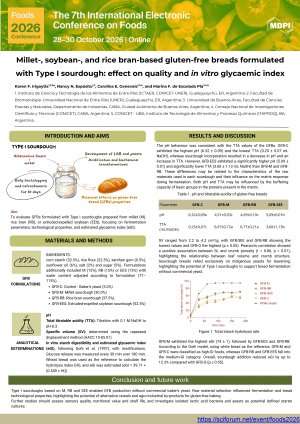
Gluten-free breads (GFBs) are typically formulated with refined flours and starches, and are characterised by the absence of the viscoelastic gluten network, which compromises the structural integrity and promotes rapid staling and starch digestibility. The aim of this study was to evaluate GFB formulated with Type I sourdough (SD) from millet (M), rice bran (RB), or extruded-expelled soybean (SEE), on fermentation parameters, technological properties, and estimated glycaemic index (eGI). GFB were prepared with 30.0 SD-M (GFB-M), 37.5 SD-RB (GFB-RB), or 52.5 SD-SEE (GFB-SEE) g.100g-1 (d.b.). The control formulation without sourdough (GFB-O) was prepared with dehydrated baker's yeast and contained 15.0 M, 15.0 RB and 15.0 SEE g.100g⁻¹ (d.b.) Total titratable acidity (TTA) was determined by titration with 0.1 M NaOH to pH 8.3. Specific volume (SV, cm³·g⁻¹) was measured using the rapeseed displacement method (AACC 10-05.01) and eGI was determined using an in vitro methodology. GFB-O showed the highest pH and lowest TTA (6.32 ± 0.09; 0.25 ± 0.07 mL NaOH), while GFB-M, GFB-RB and GFB-SEE presented significantly lower pH and higher TTA than GFB-O (p ≤ 0.05). SV ranged from 2.2 to 4.3 cm³/g, with GFB-SEE and GFB-RB showing the lowest values and GFB-O the highest (p ≤ 0.05). GFBs with SD addition had a significantly reduced eGI, with a maximum reduction of 12.3% compared to GFB-O (p ≤ 0.05). Overall, the use of Type I sourdough process modified the fermentation dynamics and quality characteristics of GFBs, thereby affecting both technological and nutritional properties in the formulations.
Keywords
firmness
acidification
by-products
natural leavening agents
Poster
Irigoytia.pdf
Species- and Tissue-Specific Accumulation of Cd, Cu and Zn in Wild Mushrooms from Leicestershire, UK
Development of Nutrient-Enriched Fish Pizza Incorporated with Pangasianodon hypophthalmus Surimi Powder and Its Quality Assessment