Event submissions
Published
This submission belongs to the session G. Food Safety, Toxicology & Quality of the event The 7th International Electronic Conference on Foods
Published date
23 Oct, 2026
Academic Editor
 Esther Sendra
Citation
Nika Lovrincevic Pavlovic, Ivan Miskulin, Ivana Kotromanovic Simic, Matea Matic Licanin, Darko Kotromanovic, Jelena Kovacevic, Lea Dumic, Maja Miskulin, Cumulative Risk Characterization of Bisphenol Residues in Food Contact Materials During the EU Regulatory Transition, in Proceedings of The 7th International Electronic Conference on Foods, 28 October–30 October 2026, MDPI: Basel, Switzerland
Share
Email
Facebook
Twitter
LinkedIn
Cumulative Risk Characterization of Bisphenol Residues in Food Contact Materials During the EU Regulatory Transition

Nika Lovrincevic Pavlovic 1

Ivan Miskulin 1

Ivana Kotromanovic Simic 1
Matea Matic Licanin 1
Darko Kotromanovic 1
Jelena Kovacevic 1
Lea Dumic 1
Maja Miskulin 1
1. Department of Public Health, Faculty of Medicine Osijek, The Josip Juraj Strossmayer University of Osijek, 31000, Osijek, Croatia
Abstract
Introduction:
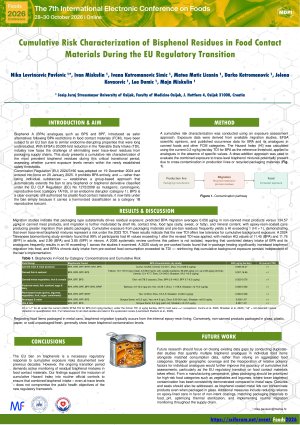
Bisphenol A (BPA) analogues, introduced as safer alternatives following BPA restrictions in food contact materials (FCM), have been subject to an EU ban due to similar endocrine-disrupting properties. With EFSA's 20,000-fold reduction in the Tolerable Daily Intake (TDI), industry now faces the challenge of eliminating even trace-level residues from packaging supply chains. This study presents a cumulative risk characterization of the most prevalent bisphenol residues during this critical transitional period, assessing whether current exposure levels remain within the newly established safety thresholds.
Methods:
A cumulative risk characterization was conducted using an exposure assessment approach. Exposure data were derived from available migration studies, EFSA scientific opinions, and published occurrence data for BPA and its analogues in canned foods and other FCM categories. The Hazard Index (HI) was calculated using the current 0.2 ng/kg bw/day TDI for BPA as the reference threshold, applied to analogues in the absence of specific values. A dose-addition approach was used to evaluate the combined exposure to trace-level bisphenol mixtures potentially present due to cross-contamination in production lines or recycled packaging materials.
Results and Discussion:
Cumulative exposure from packaging materials and pre-ban residues frequently yields a HI exceeding 1, demonstrating that even trace-level bisphenol mixtures represent a risk under the 2023 TDI. These results indicate that the new TDI offers little tolerance for cumulative background exposure. We also discuss the implications of the group-prohibition approach in light of these findings.
Conclusions:
The EU ban on bisphenols is a necessary regulatory response to cumulative exposure risks documented over previous decades. However, the ongoing transition period demands active monitoring of residual bisphenol mixtures in FCM. Our findings support the inclusion of cumulative HI into routine official controls to ensure that combined bisphenol intake – even at trace levels – does not compromise the public health objectives of the new regulatory framework.
Keywords
Bisphenol A
bisphenol analogues
Cumulative Risk
Food Contact Materials
Hazard Index
Poster
Lovrincevic Pavlovic Foods conference 2026.pdf
FOOD–DRUG INTERACTIONS: KNOWLEDGE, TRAINING, AND COUNSELLING PRACTICES AMONG PORTUGUESE COMMUNITY PHARMACISTS — A PRELIMINARY CROSS-SECTIONAL STUDY
VALORIZATION OF INDUSTRIAL ORANGE RESIDUES: EFFECT OF ESSENTIAL OIL EXTRACTION ON BIOACTIVE COMPOUNDS AND TOCOPHEROL PROFILE