Event submissions
Published
This submission belongs to the session E. Sustainable Food System & Food Security of the event The 7th International Electronic Conference on Foods
Published date
23 Oct, 2026
Academic Editor
 Abdalbasit Adam Mariod
Citation
Cecilia Dauber, Ignacio Vieitez, Cecilia Abirached, Carla Bonifacino, VALORIZATION OF INDUSTRIAL ORANGE RESIDUES: EFFECT OF ESSENTIAL OIL EXTRACTION ON BIOACTIVE COMPOUNDS AND TOCOPHEROL PROFILE, in Proceedings of The 7th International Electronic Conference on Foods, 28 October–30 October 2026, MDPI: Basel, Switzerland
Share
Email
Facebook
Twitter
LinkedIn
VALORIZATION OF INDUSTRIAL ORANGE RESIDUES: EFFECT OF ESSENTIAL OIL EXTRACTION ON BIOACTIVE COMPOUNDS AND TOCOPHEROL PROFILE

Cecilia Dauber 1

Ignacio Vieitez 1

Cecilia Abirached 2

Carla Bonifacino 2
1. Food Technology Area, Department of Food Science and Technology, Universidad de la República, Ave. Gral. Flores 2124, Montevideo, Uruguay
2. Food Chemistry Area, Department of Food Science and Technology, Universidad de la República, Ave. Gral. Flores 2124, Montevideo, Uruguay
Abstract
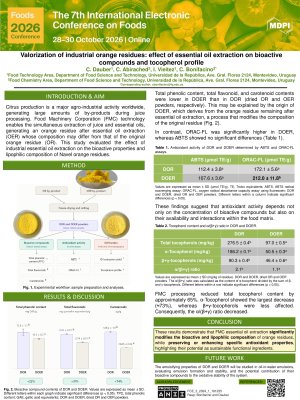
Citrus production is a major agro-industrial activity worldwide, generating large amounts of by-products during juice processing. Food Machinery Corporation (FMC) technology enables the simultaneous extraction of juice and essential oils, generating an orange residue after essential oil extraction (OER) whose composition may differ from that of the original orange residue (OR). This study evaluated the effect of industrial essential oil extraction on the bioactive properties and lipophilic composition of Navel orange residues. OR and OER by-products were freeze-dried and milled, yielding dried powders designated as DOR and DOER, respectively. Total phenolic content (TPC), total flavonoids, carotenoids, and antioxidant activity (ABTS and ORAC-FL assays) were determined. Oil extraction yield was determined, and the tocopherol profile was evaluated by chromatographic analysis. DOR showed higher contents of TPC (12.8 ± 1.1 vs. 10.5 ± 0.2 mg GAE/g), total flavonoids (0.97 ± 0.01 vs. 0.74 ± 0.01 mg quercetin equivalents/g), and carotenoids (129.2 ± 1.9 vs. 74.05 ± 0.02 μg/g) than DOER. However, ORAC-FL values were significantly higher in DOER (212.0 ± 5.6 µmol TE/g) than in DOR (172.1 ± 5.6 µmol TE/g), whereas no significant differences were observed by ABTS. These findings suggest that antioxidant activity depends not only on the concentration of bioactive compounds but also on their availability and interactions within the food matrix. FMC processing reduced total tocopherol content by approximately 65%, from 276.5 ± 0.4 to 97.0 ± 0.5 mg/kg of residue. α-Tocopherol was the most affected homologue, decreasing from 186.2 to 50.5 mg/kg of residue (≈73% reduction), whereas β+γ-tocopherols showed a lower decrease. This differential behavior resulted in a reduction of the α/(β+γ) ratio from 2.1 to 1.1. These results demonstrate that FMC essential oil extraction significantly modifies the bioactive and lipophilic composition of orange residues, while preserving or enhancing specific antioxidant properties, highlighting their potential as sustainable functional ingredients.
Keywords
Orange by-products
Essential oil extraction
FMC technology
Bioactive compounds
Antioxidant activity
Tocopherols
Circular economy
Functional ingredients
Poster
Poster_Foods_CBonifacino.pdf
Cumulative Risk Characterization of Bisphenol Residues in Food Contact Materials During the EU Regulatory Transition
Comparative Evaluation of Lakatan and Saba Banana Peel Coffee Powders as Caffeine-Free Beverage Alternatives