Event submissions
Published
This submission belongs to the session E. Sustainable Food System & Food Security of the event The 7th International Electronic Conference on Foods
Published date
23 Oct, 2026
Academic Editor
 Theodoros Varzakas
Citation
Sherrey Justynne Pastor, Felicithie Añosa, Ahnmirsten Cruz, Justin Cyril Nadala, Erwin Limbo Descallar, Comparative Evaluation of Lakatan and Saba Banana Peel Coffee Powders as Caffeine-Free Beverage Alternatives, in Proceedings of The 7th International Electronic Conference on Foods, 28 October–30 October 2026, MDPI: Basel, Switzerland
Share
Email
Facebook
Twitter
LinkedIn
Comparative Evaluation of Lakatan and Saba Banana Peel Coffee Powders as Caffeine-Free Beverage Alternatives

Sherrey Justynne Pastor 1
Felicithie Añosa 1
Ahnmirsten Cruz 1
Justin Cyril Nadala 1
Erwin Limbo Descallar 1
1. Department of Food Technology, Polytechnic University of the Philippines, Manila, Philippines
Abstract
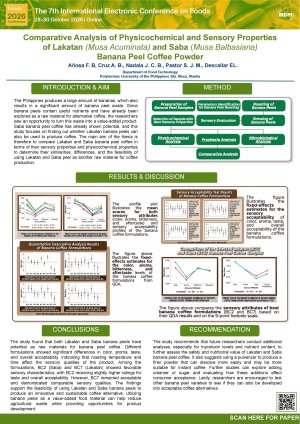
This study evaluated the potential of Lakatan (Musa acuminata) banana peel as a raw material for the production of a roasted coffee-like beverage powder and compared its sensory, physicochemical, microbiological, and proximate properties with those of Saba (Musa balbisiana) banana peel beverage powder. Banana peels were cleaned, scraped, cut, roasted, ground, and brewed, with roasting treatments varying from 180 to 190°C and 15 to 25 min. Nine roasting treatments were subjected to sensory evaluation by 45 black coffee-drinking panelists using Quantitative Descriptive Analysis and a 9-point hedonic scale. Significant differences were observed among formulations in color, aroma, bitterness, and aftertaste based on QDA (p < 0.05), indicating that roasting condition and banana variety influenced the development of coffee-like sensory attributes. Hedonic scores for color, aroma, taste, and overall acceptability also differed significantly among treatments (p < 0.05), suggesting differences in panelist preference. Among the Lakatan formulations, BC7 (185°C for 20mins) was identified as the most acceptable treatment, exhibiting a very dark brown color, slightly perceptible coffee-like aroma, moderate bitterness, and moderately perceptible aftertaste. For Saba, BC2 (190°C for 15mins) showed comparable sensory characteristics and obtained higher taste and overall acceptability scores. The selected Lakatan and Saba formulations were both dark earthy brown, low in acidity, caffeine-free (<0.01 g/100 g), and free from detectable arsenic and lead. Coliform counts were <10 CFU/g, while aerobic plate counts were within the acceptable limit for powdered beverages. Proximate analysis showed that Lakatan had higher moisture and carbohydrate contents, whereas Saba had higher crude fat and ash contents. Results demonstrate that both Lakatan and Saba banana peels can be processed into microbiologically acceptable, caffeine-free roasted beverage powders with distinct sensory and compositional characteristics, supporting their potential as sustainable coffee alternatives and value-added products from banana peel waste.
Keywords
Banana Peel
Caffeine-free Coffee
Valorization
Acceptability
Poster
Banana Coffee Poster.pdf
VALORIZATION OF INDUSTRIAL ORANGE RESIDUES: EFFECT OF ESSENTIAL OIL EXTRACTION ON BIOACTIVE COMPOUNDS AND TOCOPHEROL PROFILE
Nutritional Characterization and Bioactive Potential of Dehydrated Duckweed (Lemna minor) for Food and Feed Applications