Event submissions
Published
This submission belongs to the session E. Sustainable Food System & Food Security of the event The 7th International Electronic Conference on Foods
Published date
23 Oct, 2026
Academic Editor
 Siva S. Panda
Citation
Maja Repajić, Siniša Srečec, Renata Erhatić, Matea Habuš, Silvije Jerčinović, Marcela Andreata Koren, Chemical characterization of condensate as a by-product in chamomile drying process, in Proceedings of The 7th International Electronic Conference on Foods, 28 October–30 October 2026, MDPI: Basel, Switzerland
Share
Email
Facebook
Twitter
LinkedIn
Chemical characterization of condensate as a by-product in chamomile drying process

Maja Repajić 1

Siniša Srečec 2
Renata Erhatić 2
Matea Habuš 3
Silvije Jerčinović 3
Marcela Andreata Koren 3
1. University of Zagreb, Faculty of Food Technology and Biotechnology, Laboratory for Technology of Fruits and Vegetables Preservation and Processing, Pierottijeva 6, 10000 Zagreb, CROATIA
2. Krizevci University of Applied Sciences, Department of Plant Production, M. Demerca 1, 48260 Križevci, CROATIA
3. Križevci University of Applied Sciences, Department of Management in Agriculture, M. Demerca 1, 48260 Križevci, CROATIA
Abstract
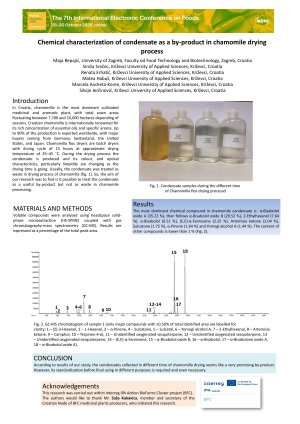
AIM: In Croatia, chamomilla is the most dominant cultivated medicinal and aromatic plant, with total sown areas fluctuating between 7,700 and 10,000 hectares depending of seasons. Croatian chamomilla is internationally renowned for its rich concentration of essential oils and specific aroma. Up to 90% of the production is exported worldwide, with major buyers coming from Germany, Switzerland, the United States, and Japan. Chamomilla flos dryers are batch dryers with drying cycle of 15 hours at approximate drying temperature of 35 – 45 °C. During the drying process the condensate is produced and its colour, and optical characteristics, particularly limpidity are changing as the drying time is going. Usually, the condensate was treated as waste in drying process of chamomilla. So, the aim of our research was to find is it possible to treat the condensate as a useful by-product but not as waste in chamomile processing. ANALYTICAL METHOD: Volatile compounds were analysed using headspace solid-phase microextraction (HS-SPME) coupled with gas chromatography-mass spectrometry (GC-MS). Results are expressed as a percentage of the total peak area and reported as mean ± standard deviation of three replicates. RESULTS: The most dominant chemical compound in chamomile condensate is α-Bisabolol oxide A (35.22 %), than follows α-Bisabolol oxide B (29.52 %), 2-Ethylhexanol (7.64 %), α-Bisabolol (6.51 %), (E,E)-α-Farnesene (2.25 %), Artemisia ketone (2.04 %), Sulcatone (1.75 %), α-Pinene (1.64 %) and Yomogi alcohol A (1.44 %). The content of other compounds is lower than 1 %. CONCLUSION: According to results of our study, the condensates collected in different time of chamomilla drying seems like a very promising by-product. However, its standardization before final using in different purposes is required.
Keywords
chamomilla flos drying
condensate chemical charaterization
waste
by-product
Poster
Srecec_et_al_7th_food_conference.pdf
Mineral profiles across the Iberian rice chain: from soil to grain.
Development of Marmalade with an Improved Nutritional Profile Using LMA Pectin and Polydextrose